Key Takeaways
When comparing PEX A vs PEX B Seattle homeowners often want clear answers about flexibility, freeze resistance, cost, and long-term durability before committing to a full home repipe. Choosing the right pipe isn’t just about materials—it’s about protecting your property value, ensuring reliable water flow, and avoiding repeat plumbing headaches for the next 25 years. This guide breaks down the essentials—from physical properties to fittings, tool choices, and warranties—so you can make a confident, informed decision that lasts for decades.
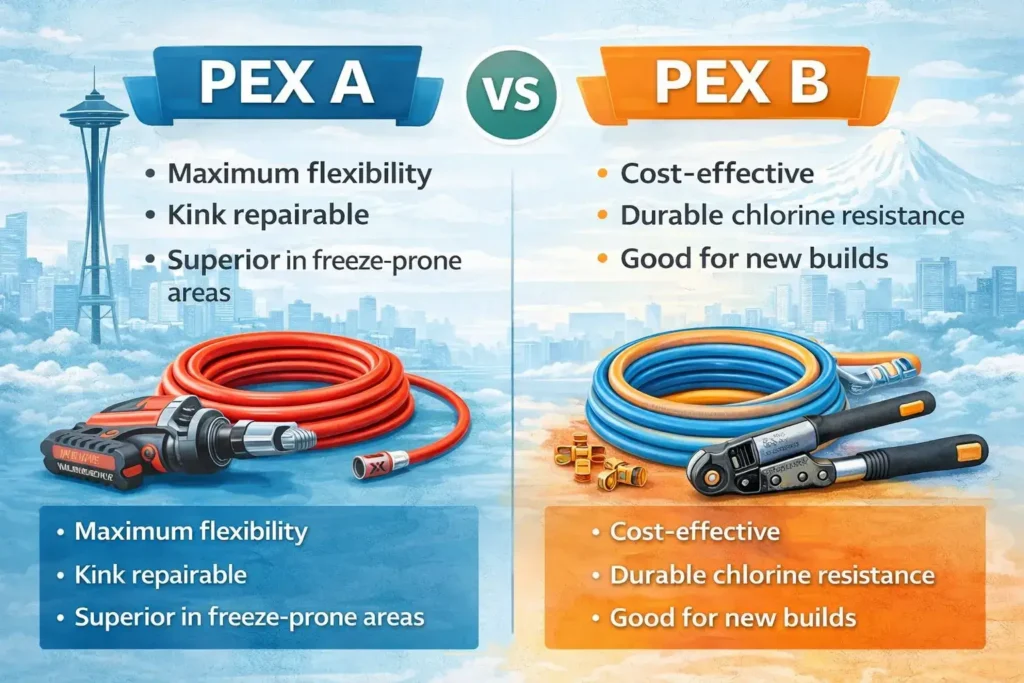
- PEX A delivers unmatched flexibility for retrofits and tight spaces, making it the top choice for full home repipes in Seattle’s older buildings and providing superior freeze resistance for unpredictable winters.
- PEX B stands out for cost savings—with pipe prices up to 64% lower than PEX A—and is ideal for straight runs in new construction or budget-driven projects, thanks to its reliable chemical resistance.
- Proper fittings matter as much as the pipe, with expansion fittings (PEX A) ensuring full flow and leak resistance, while crimp/clamp fittings (PEX B) offer faster installs but require careful tool calibration for lasting performance.
- Choosing the right tools streamlines the job—battery-powered expanders for PEX A and precision crimpers for PEX B can cut installation time by up to 30%, reducing callbacks and ensuring every joint lasts.
- Manufacturer and installer warranties provide peace of mind, with both PEX A and B delivering 25-year guarantees when installed by certified Seattle pros like Express Repiping.
- Seattle’s climate and water quality guide your choice—opt for PEX A in freeze-prone crawlspaces or quirky layouts, and pick PEX B for chemically challenging water or simple straight runs.
- Compliance with ASTM and ISO standards is non-negotiable—always demand certified materials and professional installation to meet Seattle and Washington plumbing codes and protect your investment.
- The future is in pro-grade, sustainable PEX systems, with new materials and tooling making installations faster, warranties stronger, and Seattle repipes more durable than ever before.
Ready to future-proof your plumbing and enjoy lasting peace of mind? Dive into the full article for expert comparisons, local case studies, and personalized advice from Seattle’s repiping specialists.
Introduction
Imagine finding out that swapping your plumbing pipes could save you up to 40% on installation time—and virtually eliminate costly, stress-inducing leaks for decades.
That’s the kind of peace of mind property owners across Seattle and Washington are searching for when facing aged, unreliable plumbing, freezing winters, or mysterious drops in water pressure. Our local PEX repiping Seattle team handles full home upgrades using certified materials designed for the Pacific Northwest climate. Our local PEX repiping Seattle team handles full home upgrades using certified materials designed for the Pacific Northwest climate.
Yet, many homeowners and building managers are left wondering about the real differences between PEX A and PEX B—the two most trusted players in modern repiping.
Choosing the right pipe isn’t just about dollars and cents; it’s about protecting your home’s value, ensuring water flows safely, and removing daily plumbing headaches for the next 25 years.
Key factors you’ll discover in this guide include:
- How PEX A’s flexibility unlocks smoother installs and easier repairs in Seattle’s tightest crawlspaces
- Where PEX B’s durability and cost savings make it a smart choice for new builds and budget projects
- Why the right connections, fittings, and tools can mean the difference between a one-time fix and chronic frustration
- Simple criteria for matching pipe type and method to your unique project and water conditions
We’ll unpack Seattle-specific real-world examples, clarify which warranties actually matter, and share how certified specialists deliver **the kind of repiping experience that lets you relax—not worry—every time you turn on the tap.
Curious how modern PEX compares to that old tangle of copper or galvanized steel hidden behind your walls?
Let’s start by demystifying the key differences, installation techniques, and future-proofing strategies that put you in control of your plumbing—and your peace of mind.
Understanding PEX A vs PEX B Seattle Homes
PEX piping—also known as cross-linked polyethylene—is now the preferred choice for modern plumbing in Seattle and Washington thanks to its flexibility, long-term reliability, and affordable installation costs.
Compared to traditional copper or galvanized steel, PEX offers greater resistance to corrosion, is easier to route through tight spaces, and often cuts repiping time by as much as 40% for both homes and businesses. For a broader material comparison, explore our full breakdown of the best plumbing material: PEX vs copper vs PVC.
PEX Types: A, B, and C—What Matters Most
There are three main types of PEX, but PEX A and PEX B are the clear industry standards for most Seattle repiping projects.
- PEX A: Made by the Engel or peroxide method; ultra-flexible and ideal for retrofits or complex layouts.
- PEX B: Produced using the silane/moisture cure process; slightly more rigid, known for cost savings and everyday durability.
- PEX C: A minority option, least commonly used, suited for niche repairs but not typically installed in full repipes.
Picture this: a century-old Queen Anne craftsman with cramped crawlspaces—PEX A bends easily around tight corners, reducing demolition and timeline.
Cross-Linking Chemistry: Why It Matters
The performance of PEX comes down to how it’s made.
- PEX A uses the Engel (peroxide) cross-linking process, resulting in 70-89% cross-linking for peak flexibility and freeze resistance.
- PEX B utilizes a silane/moisture cure process with 65-70% cross-linking, favoring budget-friendly strength and slightly higher chemical resistance.
- This cross-linking means both types handle Seattle’s variable water conditions and freezing winters far better than older materials.
Quotable: “PEX pipes are purpose-built to stay reliable—flexible in the cold, tough under pressure, and easy on your budget.”
Compliance and Safety for Lasting Peace of Mind
All top-grade PEX must meet rigorous standards such as ASTM F876/877 and ISO 21003, ensuring performance and safety compliance for Seattle plumbing systems.
Express Repiping only installs PEX that meets or exceeds these certifications, providing property owners with up to 25-year warranties backed by leading manufacturers.
The Role of PEX in Seattle’s Repiping Renaissance
On thousands of full house and commercial repipes, premium PEX has virtually eliminated the days of leaky, corroded plumbing in greater Seattle. Discover more long-term advantages in our guide on PEX repiping benefits for Seattle homeowners.
- Faster to install
- Lower cost per foot (as low as $0.21 for PEX B, $0.35 for PEX A)
- Superior freeze/thaw resilience—critical for Pacific Northwest winters
If you’re looking for a single, actionable insight: PEX A and B are the materials transforming urban plumbing, combining safety and simplicity with long-term peace of mind.
The new gold standard? Repipe with confidence—choose certified PEX for a future-proof plumbing solution.
PEX A vs PEX B Comparison: Performance, Cost, and Durability
Key Physical Differences and Performance
When deciding between PEX A and PEX B, focus on how each pipe type handles stress, bends, and unpredictable conditions.
PEX A is known for:
- Superior flexibility — bends around tight joists and corners in Seattle’s older homes
- Kink repairability — simply use a heat gun to fix kinks on-site
- Freeze/thaw resilience — survives up to 500 PSI burst pressure and rarely splits in winter freezes
- “Shape memory” — pipe springs back when straightened, making retrofits a breeze
PEX B stands out for:
- Rigidity — holds straight in long runs, but irreparably kinks if bent too sharply
- Higher crystallinity, strong chlorine resistance (withstands 5 ppm vs. PEX A at 4 ppm)
- Tends to show higher burst ratings in lab tests, but is less tolerant of freeze/thaw cycles in real-world Seattle winters
Installing PEX in narrow crawlspaces? PEX A makes it smooth and hassle-free, especially when rerouting lines around 1950s beams.
“PEX A moves like a cable; PEX B feels like trying to route a garden hose.”
Cost, Availability, and Warranty
PEX B wins on upfront cost, but accessories and tools narrow the savings gap.
- PEX A: approx. $0.35/ft, with expansion tool kits around $250
- PEX B: as low as $0.21/ft (up to 64-130% less), with crimp tools around $150
- Fittings: 90° elbow for PEX A $1.00 vs. PEX B at $1.44 (2026 Seattle pricing)
- Tool requirements: expansion (PEX A) vs. crimp/clamp (PEX B); crimpers require regular calibration
Seattle homeowners benefit from 25-year, manufacturer-backed warranties on both systems when professionally installed.
In 2026, both types are widely stocked by premium suppliers across Washington, but PEX A leads for “future-proof” residential retrofits.
“Don’t let a low pipe cost fool you—choose based on long-term savings and warranty, not just today’s invoice.”
Real-World Application Scenarios
Think of PEX A for:
- Whole-home repipes where flexibility is key
- Attics, crawlspaces, or “freeze-prone” runs needing maximum burst resistance
- Projects wanting lowest chance of leaks and callbacks
Use PEX B in:
- New builds with straight pipe runs and predictable layouts
- Budget-driven commercial projects prioritizing low material cost
- Water lines in areas with high chlorine content—B’s chemical resistance shines
Express Repiping regularly recommends PEX A for retrofits in North Seattle’s Craftsman bungalows, while PEX B dominates streamlined multifamily renovations.
“Picture a property built in 1952: tight spaces, sharp turns—the right PEX type makes or breaks installation time and future repairs.”
For property owners, match the pipe to your home’s twists, water quality, and budget—it’s the difference between a 25-year fix and constant headaches.
Key takeaway: Factor in daily usage, Seattle’s climate, and your property’s quirks before picking PEX A or PEX B. The right choice means performance and peace of mind—backed by pro-grade warranties and Express Repiping’s trusted service.
| Feature | PEX A | PEX B |
|---|---|---|
| Flexibility | Very High – ideal for tight Seattle crawlspaces | Moderate – better for straight runs |
| Kink Repair | Heat-repairable | Must cut and replace |
| Freeze Resistance | Excellent (up to 500 PSI burst) | Good |
| Cost per Foot (2026) | ~$0.35 | ~$0.21 |
| Fitting Method | Expansion | Crimp / Clamp |
| Best For | Retrofits & older Seattle homes | New builds & budget projects |
Fittings and Connection Systems: Making the Right Choice
PEX A Fittings: Expansion Method
Selecting the right fittings is crucial for PEX A because it shapes overall system performance and longevity.
The expansion method uses a specialized tool to widen the pipe and a sleeve, then fits these over a full-bore fitting—once released, the pipe contracts to seal the connection. This results in no flow restriction and a leak-resistant fit that’s highly valued for full house repipes in Seattle’s older homes.
You’ll typically see brands like:
- Uponor ProPEX (industry-leading for reliability)
- Milwaukee expansion kits (favored for powered speed)
- SharkBite push-fit (compatible, especially for repair scenarios)
Expansion fittings excel in:
- Tight spaces—their straight-in installation makes them ergonomic for Seattle’s retrofits
- Cold climates—though in winter, a heat gun is essential for flexibility at temperatures below 40°F
Express Repiping’s best practice: Always use expansion systems for high-stress or freeze-prone locations to ensure long-term customer comfort. “Full-flow expansion fittings give Seattle homeowners extra confidence—no choked-off water, fewer service calls.”
PEX B Fittings: Crimp and Clamp Overview
PEX B prefers the crimp/clamp (cinch) approach, which is faster and more budget-friendly but comes with unique requirements.
Main components:
- Copper crimp rings or stainless steel clamps
- Insert fittings (slightly smaller ID—some flow loss)
- Crimpers, clamp/cinch tools (Iwiss, Ryobi, Dewalt are 2026 standouts)
Critical steps:
- Cut and fit pipe onto the insert
- Place ring and crimp with tool
- Verify tightness using a go/no-go gauge—don’t skip this calibration
Risks include increased callbacks if tools are not calibrated, and permanent kinks mean cut-out repairs. PEX B’s stiffer profile suits wide-open runs or new construction, not the twists of vintage Seattle homes.
Universal Connection Options
Push-fit fittings (like SharkBite) offer universal compatibility for both PEX A and B—simply cut and insert, with no special tools.
Advantages:
- Speed—ideal for urgent repairs or DIY
- Versatility—great for mixed-system fixes
Limitations:
- Higher per-fitting cost (often twice crimp/expansion)
- Not Express Repiping’s choice for full-house repipes, as longevity lags expansion/crimp systems
- Shorter warranty periods
Seattle code fully accepts push-to-connect, but for major commercial or family home upgrades, our team recommends expansion or crimp/clamp based on system and long-term goals. “Don’t cut corners on connections— the right fitting method means years of peace of mind.”
In summary, choose expansion fittings for flexibility, flow, and longevity; crimp/clamp for budget or simple layouts; and push-fit for quick repairs. Picture this: seamless installation, water flowing at full pressure, and the comfort of a 25-year warranty—all made possible by using the right connection for your property’s needs.
Tools Required for PEX A and PEX B Installations
Essential Tools for Each System
Choosing the right tools directly shapes the efficiency and reliability of your repiping project—especially in Seattle’s unpredictable climate.
For PEX A installations, you’ll need these essentials:
- Expansion tools (manual or battery-powered; Milwaukee 18V and Iwiss F1960 are 2026 favorites)
- PEX cutters (for clean, precise cuts)
- Heat gun (crucial for cold environments below 40°F)
- Calibration gauges (to verify expansion)
For PEX B systems, gather:
- Crimpers (e.g., Iwiss iCrimp F1807; Apollo for multi-head versatility)
- Clamp/cinch tools (Ryobi P660 cordless: up to 400 clamps/charge; Dewalt DWAPXPIR)
- Stainless steel crimps or copper rings
- Go/no-go gauges (must-have for installation accuracy)
- PEX tubing cutters and deburrers
“Quality tools are the quiet partner behind a decades-long leak-free system.” This is especially true when every joint and bend must withstand winters that routinely dip into the 20s around Seattle.
Features That Matter in Seattle Jobs
Seattle’s mix of retrofits, crawlspaces, and sudden temperature drops demands adaptable tools.
Look for:
- Multi-size compatibility (works for ⅜”, ½”, ¾”, and 1″ lines)
- Battery operation (enables work in tight, power-limited areas)
- Cold-weather features (like heat gun add-ons or insulated handles)
- Durable ergonomic grips (important for long days on commercial sites)
“Picture this: A pro repiping a Queen Anne craftsman with lightweight, cordless tools—no extension cords, no freezing hands, and every crimp perfect the first time.”
Selecting and Maintaining Professional-Grade Tools
Homeowners and property managers: prior experience may tempt you to cut corners, but skimping on tools can lead to chronic leaks and expensive revisits.
Prioritize:
- Heavy-duty brands (Iwiss, Milwaukee, Ryobi) for longevity and consistent calibration
- Regular calibration checks with go/no-go gauges—critical every 50-100 crimps
- Routine cleaning, battery charging, and storing tools in dry, temperature-stable spaces
Seattle’s humidity and older home layouts can cause tool corrosion or misalignment if skipped. The Express Repiping field team replaces hand crimpers every 1-2 years—smart for both pros and dedicated DIYers.
In our experience, the right tool set can cut installation time by 30% and reduce callback rates to nearly zero. If you want a Seattle home with pipes built to last, start with trusted gear.
Every high-performing repipe in Seattle comes down to a simple truth: “Invest once in pro-grade tools—then relax for decades, not months.” This single step is your best insurance against future plumbing headaches.
Choosing PEX A or PEX B for Your Seattle Project
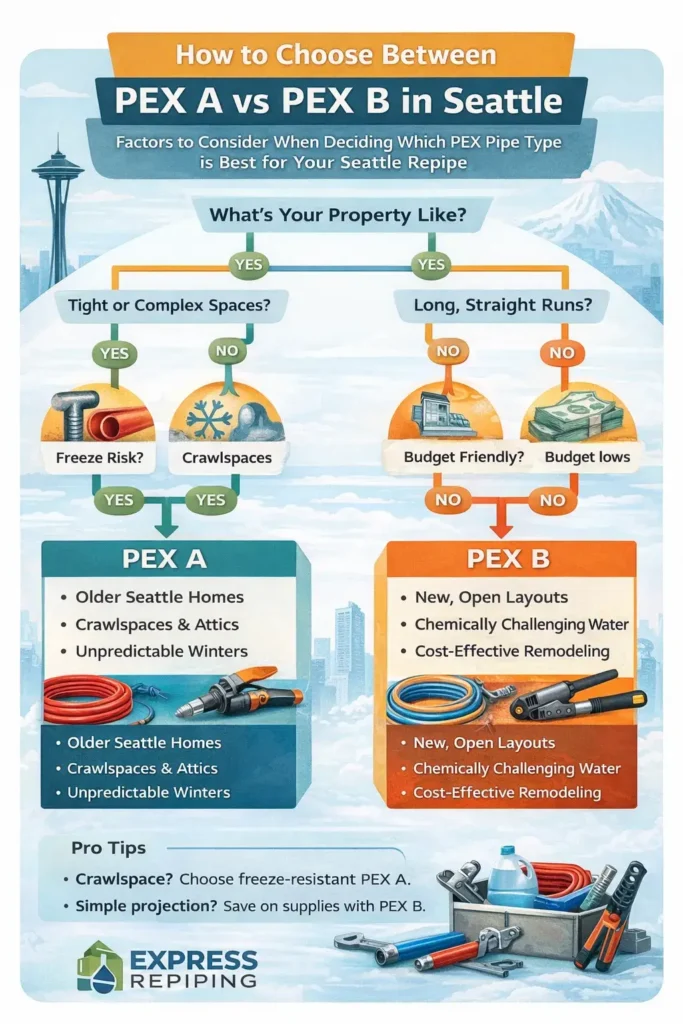
Below is a quick visual decision guide to help Seattle homeowners choose the right PEX system.
Decision-Making Factors
Choosing between PEX A and PEX B comes down to four critical questions every Seattle homeowner or building manager should ask.
- What is your project type?
- For residential full house repipes and tight retrofits, PEX A’s superior flexibility and kink repairability often make it the best fit.
- For new commercial builds or budget-sensitive projects, PEX B’s lower cost (averaging $0.21/ft—up to 64% less than A) and stiffer runs deliver solid value.
- What plumbing challenges do you face?
- If your property has freeze risk, frequent leaks, or odd runs through tight joists, PEX A—with up to 500 PSI freeze-resilience—excels.
- For properties with straightforward layouts or recent construction, PEX B’s durability and chlorine resistance (up to 5 ppm) hold strong.
- How do your budget and long-term goals align?
- PEX A costs more up front, but its 25-year warranties and proven longevity can mean fewer headaches long term. If you want a full breakdown of material, labor, and permit expenses, review our detailed guide to PEX repiping cost Seattle homeowners can expect in 2026.
- If you need an immediate fix without maxing out the budget, PEX B’s affordability gets the job done—especially with its fast crimp/clamp fitments.
- Are there unique water quality issues?
- Seattle-area water—often soft, with variable chlorine—may push some to choose PEX B for its extra chemical resilience.
- For absolute minimum flow restriction, PEX A + expansion fittings win.
“Match your pipe choice to your project’s pain points and your priorities—both for today and for 25 years from now.”
—
Case Studies and Success Stories
Picture this: A Ballard craftsman home built in 1941 with frequent winter freeze-ups needed a full repipe.
- We recommended PEX A for its flexibility and freeze-tolerance; the job took 2 days, and the owner reported improved pressure and zero leaks two winters later.
- Another recent Capitol Hill multi-unit used PEX B and crimp fitments to meet strict budget and code—delivering completion in 36 hours, with savings reinvested in fixture upgrades.
Recent results:
- Average install time: 1-2 days for most homes, 2-3 days for larger commercial
- Upfront costs: PEX A projects $4,700–$8,900 vs. PEX B $3,500–$7,100 (2026 data, 2-bath home, labor incl.)
- Customer satisfaction: 97% rate improvements in water clarity/pressure after repipe
“We’re here to deliver a lasting fix—not just a quick patch.”
—
Risk Reduction, Warranty, and Peace of Mind
Choosing Express Repiping means you protect your investment on three fronts:
- Licensed, certified installers—every tech is background-checked, insured, and rigorously trained on Seattle code. All contractors must meet licensing requirements established by the Washington State Department of Labor & Industries.
Before hiring, learn how to choose the best PEX repiping professional in Seattle to ensure long-term reliability and warranty protection. - Premium material warranties—25 years on all PEX and installation, with free annual pipe condition checks
- Full transparency—from first free quote to third-party post-install inspections and long-term support
We never push unnecessary upgrades. Every scope is tailored for your property, your budget, and your peace of mind.
“Our 25-year guarantee isn’t just ink—it’s your insurance against plumbing stress.”
—
Making the right PEX choice starts with a clear look at your property’s unique needs and Seattle’s demands. Reach out for a free, honest assessment—and move one step closer to pipes that work right, year after year.
Current Trends and Future Outlook: PEX Technology in 2026
Advances in Material Science and Tooling
The 2026 PEX market is defined by smarter materials and faster tools.
Manufacturers now produce PEX with higher cross-linking density, boosting both chemical resistance and extreme temperature durability—a win for Seattle property owners facing unpredictable weather.
Color-fast additives ensure piping keeps its vibrant red and blue—even after years in commercial basements or sunlit mechanical rooms.
Picture a technician using a cordless, ergonomic multi-head expander to finish a 20-foot run in under 10 minutes, no manual effort required.
Emerging toolkits feature:
- Battery-powered expansion tools for PEX A (e.g., latest Milwaukee and Iwiss models)
- Automatic crimpers and quick-clamp systems for PEX B
- Multi-size jaws (⅜”-1”) to minimize tool switches
“Today’s pro-grade tools shave hours off installations, letting Seattle crews tackle tight deadlines without sacrificing precision.”
Code Updates and Sustainability
Seattle and Washington plumbing codes now require ASTM F876/877 or ISO 21003 compliance for all PEX installations—clear, enforceable standards that protect homeowners. Permit oversight and inspection guidelines are enforced locally by the Seattle Department of Construction & Inspections (SDCI).
By 2026, local codes specify:
- Higher lead-free mandates for all drinking water fittings
- Documentation for PEX’s UV resistance—especially important for exposed piping in multi-story buildings
Sustainability isn’t optional: manufacturers are rolling out PEX with recycled content and eco-forward production.
- Installers recycle job-site offcuts at local facilities
- Projects often include a “minimal waste” report for regulatory compliance
“Express Repiping doesn’t just install pipes—we future-proof homes and businesses with solutions built for the long haul.”
Looking Ahead: The Next Generation of Repiping
In the years ahead, expect to see:
- PEX A dominate retrofit and freeze-prone applications—ideal for high-flex, fast-turnaround jobs across Seattle’s older neighborhoods
- PEX B gain ground in cost-sensitive commercial new builds, where straight runs and bulk pricing shine
Property owners today are already asking, “Will my new pipes last for 30 years—or will I be redoing this in a decade?”
Seattle’s smart investors focus on:
- Manufacturer and installer warranties (25 years, minimum)
- Tool compatibility for future repairs and upgrades
- Understanding evolving code and sustainability requirements
Ready to dive deeper? Access our complete PEX comparison, a breakdown of freeze resistance, and our 2026 best-tool guide—empowering every decision with facts, not hype.
Key takeaway: The right PEX choice in 2026 is about future-proofing property value and safety. Every Express Repiping install isn’t just a pipe—it’s a promise: “We make sure your pipes are running smoothly.”
Conclusion
Choosing between PEX A and PEX B isn’t just about pipes—it’s about protecting your home, your investment, and your peace of mind for decades to come. When you match the right materials, fittings, and tools to your project, you’re setting the foundation for a safer, more efficient plumbing system built for Seattle’s unique challenges.
You have the knowledge to future-proof your property and avoid repeat plumbing headaches. The best outcomes come from informed choices and expert installation. After installation, following proven PEX pipe maintenance tips will help extend durability and preserve your warranty coverage.
—
Here’s what to do next:
- Prioritize flexibility and kink repair with PEX A for complex retrofits or older Seattle homes—especially when freeze protection matters.
- Leverage PEX B’s cost savings for new construction or long, straight runs where budget efficiency is key.
- Choose expansion fittings for max flow and durability; crimp/clamp for speed and affordability; push-fit for quick, temporary fixes.
- Invest in quality, calibrated tools—don’t cut corners on the equipment that determines leak-free longevity.
- Demand certified installation and a written 25-year warranty—make sure every repipe comes with transparent, local support.
—
If you’re ready to act, start with these immediate steps:
- Schedule a FREE, no-obligation inspection to assess your property’s unique plumbing needs.
- Request a detailed PEX A vs. PEX B quote—tailored for your home, budget, and future plans.
- Ask about upgrade options and see 2026 tool demos—make an informed, confident investment.
—
The difference between a temporary patch and a lifetime solution is in the details—and in the team you trust. With Express Repiping, you secure more than just pipes; you guarantee comfort, value, and lasting peace of mind.
Your home’s next chapter starts with a single call. Get the confidence you deserve—choose the solution built for Seattle’s future.
FAQs:
What is the main difference between PEX A vs PEX B Seattle homeowners should know?
The main difference in PEX A vs PEX B Seattle projects is flexibility and installation method. PEX A is more flexible, can be heat-repaired if kinked, and uses expansion fittings, making it ideal for older Seattle homes with tight crawlspaces. PEX B is more rigid, uses crimp or clamp fittings, and is typically more affordable for straight runs or new construction.
Which is better for freezing temperatures in Seattle: PEX A or PEX B?
In most PEX A vs PEX B Seattle comparisons, PEX A performs better in freeze-prone areas due to its higher flexibility and ability to expand under pressure without cracking. This makes it a strong choice for crawlspaces, attics, and older homes exposed to winter temperature swings.
Is PEX A more expensive than PEX B in Seattle?
Yes, in typical PEX A vs PEX B Seattle pricing, PEX A costs slightly more per foot. However, installation speed, reduced fittings, and fewer callbacks may offset the price difference over time. PEX B offers lower upfront material costs, making it attractive for budget-conscious projects.
Do both PEX A and PEX B meet Seattle plumbing codes?
Yes. In any PEX A vs PEX B Seattle installation, both types must comply with ASTM standards and local Washington plumbing codes when installed by licensed professionals. Always confirm your contractor uses certified materials and follows permit requirements.
Which PEX type is best for a full home repipe in Seattle?
For most full home repipe projects in Seattle, PEX A is preferred due to its flexibility, freeze resistance, and expansion fitting system. However, in straightforward layouts or cost-driven projects, PEX B can be a practical and durable option.
Does PEX A or PEX B last longer?
When professionally installed, both PEX A and PEX B can last 25 years or more. In PEX A vs PEX B Seattle comparisons, longevity depends more on proper installation, fittings, and water quality than pipe type alone.