
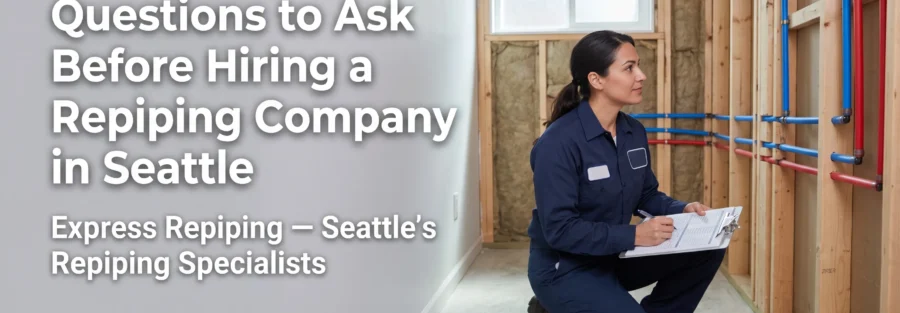
Hiring the right repiping company in Seattle is one of the most important decisions you’ll make as a homeowner — and asking the right questions upfront is what separates a smooth, on-budget project from weeks of chaos and surprise costs.
This guide gives you the exact questions to ask, red flags to watch for, and standards to hold every contractor to — before you sign anything.
Before you meet your first contractor, make sure you can get clear answers on:
- Licensing, insurance, and permit handling verified in writing
- Repiping specialization — not just general plumbing experience
- Exact materials, brands, and installation methods for your home
- Full project scope, home protection plan, and daily cleanup commitment
- Realistic timeline, named crew, and a dedicated point of contact
- Warranty terms covering both materials and labor for the long term
Ready to get started? Schedule a free inspection with Express Repiping →
Why Choosing the Wrong Repiping Company in Seattle Costs You
Ever wonder why so many Seattle homeowners end up regretting their choice of repiping company—even when they thought they’d done their homework?
A full-home repipe is one of the most important investments you’ll ever make in your property, yet skipping just a few critical questions at the start can turn that upgrade into weeks of chaos, surprise expenses, and failed inspections. In fact, homeowners who ask the right questions from the outset are 3X more likely to finish on time and on budget, compared to those who rely on first impressions or basic referrals.
You shouldn’t have to gamble with your home’s plumbing or trust a generic checklist to guide your decision. The reality? Unlicensed contractors, vague warranties, and unclear project scopes are the leading causes of costly repipe nightmares—and most issues could have been prevented with targeted questions that reveal a company’s true expertise and transparency.
So, what exactly should you ask to sidestep headaches, protect your investment, and ensure your pipes—and peace of mind—are built to last for decades? When you know which questions matter most, you’ll uncover:
- Proof of licensing, insurance, and local experience that keeps your home protected
- Clarity on materials, installation techniques, and warranty coverage for long-term confidence
- Detailed project timelines, cleanup protocols, and communication standards that eliminate disruptions
No more guessing games. By approaching repiping as a partnership—armed with the right questions—you gain control, clarity, and a smoother path to a safer, more valuable property.
Here’s how to turn every conversation with a potential repiping provider into a foundation for success—starting with the most strategic questions that Seattle’s top homeowners wish they’d asked from day one. This guide gives you the exact questions to ask when evaluating Seattle repiping specialists — red flags to watch for, and standards to hold every contractor to before you sign anything.
The Questions That Separate Good Repiping Companies From Bad Ones
Picture this: You’re preparing for a whole-house repipe—a major investment meant to protect your home’s value, comfort, and safety for decades to come.
But did you know… skipping the right questions at the start is the #1 reason Seattle homeowners regret their contractor choice?
A single misstep—like hiring an unlicensed or uninsured provider—can lead to costly damage, failed inspections, water shutoffs, and sky-high repair bills.
—
Why the Right Questions Protect Your Seattle Home
Think of asking questions as your personal safety net.
It ensures:
- City code compliance (avoiding failed inspections and fines)
- No surprises on cost, materials, or scope
- Peace of mind knowing you’re hiring a real expert, not a fly-by-night plumber
Homeowners who ask focused questions are 3X more likely to report a smooth, on-budget repipe than those who rely on assumptions or first impressions.
—
Common Repiping Mistakes Seattle Homeowners Make
There’s no shortage of disaster stories:
- “The repipe took three weeks longer than promised, with daily water shutoffs.”
- “We discovered after the fact that pipes were routed incorrectly—the inspector failed it twice.”
- “Their ‘warranty’ only covered leaks, not damage to drywall or floors. Cleanup took days.”
When you don’t confirm credentials, process details, and aftercare up front, you risk:
- Unlicensed or uninsured work—leaving you liable for accidents or city penalties
- Use of subpar materials that won’t pass inspection or last more than a few years
- Incomplete repairs, open walls, or hidden costs that appear only after installation
—
3 Questions Every Seattle Homeowner Should Ask First
Here’s a quick-start checklist every Seattle property owner should use before signing:
- Are you licensed for repiping in my city—and can I verify the number?
- What insurance protects my property if something goes wrong?
- Will you provide a written estimate including materials, permits, and warranty?
Just three targeted questions can reveal the difference between a trustworthy repiping specialist and a risky contractor.
—
When you use the right questions as your starting point, you’re not just protecting your pipes—you’re building a foundation for a stress-free, fully transparent repiping process you can trust.
Licensing & Insurance: What to Verify Before Hiring a Repiping Company in Seattle
Hiring a repiping company in Seattle isn’t just about getting the pipes replaced—it’s about protecting your home and peace of mind from day one. Ensuring your contractor is properly licensed, insured, and accountable shields you from serious legal and financial headaches.
The Foundation: State and City Plumbing Licenses
Washington law requires plumbers to hold city and state-specific licenses. This isn’t just a formality—unlicensed work can void your home insurance and risk costly code violations. Always ask for the plumber’s license number — you can verify their Washington state plumbing license directly through the Washington State Department of Labor & Industries.
- Always ask for the plumber’s license number.
- Verify credentials directly using your city or state’s official licensing website.
- Look for local experience; Seattle regulations are unique and change often.
A legitimate contractor will show credentials before you even ask. If they hesitate, that’s a red flag.
Why Insurance Matters—And What’s Required
Accidents happen—even with the best teams. That’s why liability insurance and workers’ compensation aren’t optional; they’re your safety net if damage or injury occurs during the repipe.
- Request up-to-date proof of general liability and workers’ comp insurance.
- Confirm the insurance covers both property damage and personal injury on your site.
- Scenarios to picture: If a contractor falls through your ceiling or a pipe bursts, uninsured companies leave you exposed to lawsuits or thousands in damages.
Over 20% of residential claims in Washington stem from uninsured contractors—don’t become part of that statistic.
Permits, Inspections, and Accountability
Every Seattle repiping job requires city permits and inspections. Reliable companies handle these logistics so you aren’t left in a legal gray area.
- Ask: “Will you pull all required permits and schedule mandatory inspections?”
- Request written proof that permits are secured—before any work begins.
- Companies avoiding this step put you at risk for fines and failed refis.
If your contractor suggests skipping permits, walk away. You can lose resale value or even face court-ordered pipe removal.
Licensing Questions to Ask Your Seattle Repiping Contractor
Picture yourself at the first meeting. Use these questions to get the facts fast:
- Are you licensed to do plumbing and repiping in my city/state? What’s your license number?
- Can you provide certificates of liability and workers’ comp insurance?
- Who pulls the required permits and handles city inspections?
- Will you provide paperwork for licensing, insurance, and permits before starting?
Red Flags You Can’t Ignore
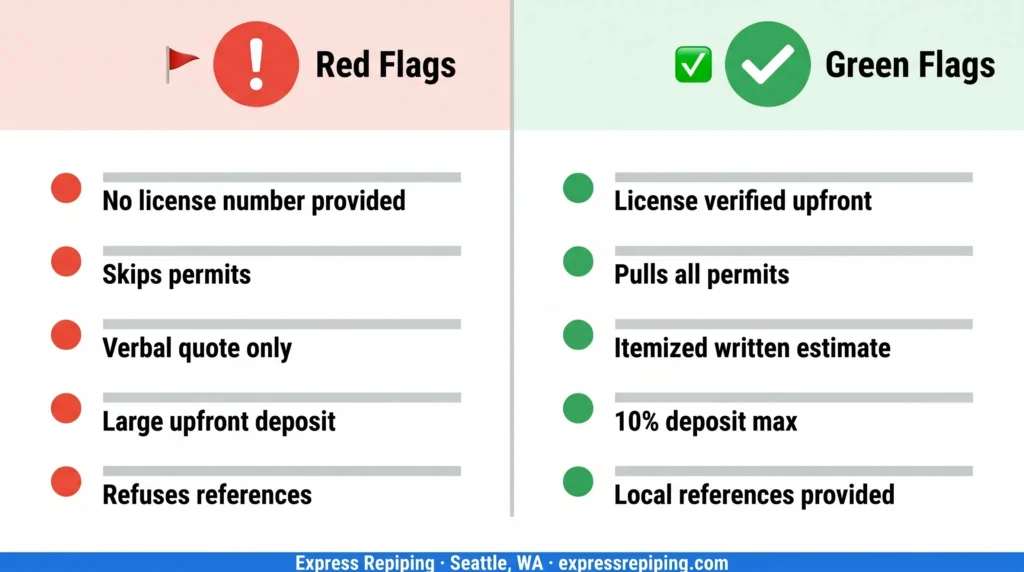
| What to Check | Green Flag | Red Flag |
|---|---|---|
| Licensing | Provides license number upfront for verification | Vague, missing, or unverifiable license info |
| Insurance | Current liability + workers’ comp certificates provided | Reluctant to share documentation |
| Permits | Pulls all permits and schedules city inspections | Suggests skipping permits to save time or money |
| Specialization | Repiping is their primary business focus | General plumber with occasional repipe work |
| References | 3–5 local references with before/after photos | Only generic reviews or refuses references |
| Estimate | Detailed written quote with itemized line items | Verbal or lump-sum quote only |
| Deposit | 10% or less upfront per Washington state law | Large cash deposit demanded before paperwork |
| Warranty | Written warranty covering materials and labor (10–25 years) | Verbal warranty or coverage under 1 year |
Peace of mind starts with due diligence. By asking for—and verifying—licenses, insurance, and permits, you’re not just protecting your wallet: you’re ensuring your repiping project meets Seattle codes, keeps your property safe, and is completed by a team that stands behind their work.
How to Evaluate a Seattle Repiping Company’s Experience
Picture this: You wouldn’t trust general car maintenance for a complex engine rebuild—repiping your home deserves the same specialist attention. If you want to understand what sets a specialist repiping company apart from a general plumber, start by asking how many whole-house repipes they complete each year.
Choosing a repiping-focused company over a general plumber can mean:
- Specialists who handle 50+ whole-house repipes a year
- Technicians with up-to-date tools, certifications, and advanced materials
- Fewer mistakes and smoother city inspections
Ask about the percentage of their business devoted to full-scope repiping, not just leak repairs or fixture swaps.
A true repiping specialist anticipates what others overlook—from the best route for piping through your 1950s structure, to code compliance in Seattle’s seismic retrofits.
Defining “Experience”—What Real Expertise Looks Like
When a company claims “years of experience,” get specific:
- How many years have they operated under their current name?
- How many whole-house repipes did they complete last year?
- Do they have recent projects on properties like yours (historic, multi-story, crawlspace, or slab)?
- Are their techs certified in PEX/copper installations versus only basic plumbing?
Example: A Seattle home built in 1964 with original galvanized pipes needs a contractor who’s replaced at least a dozen similar properties—those nuances matter for a seamless result.
How to Verify a Company’s Track Record
Don’t just take their word for it. Use these go-to strategies:
- Request 3-5 recent, local references with contact info—demand at least one from a home like yours.
- View before-and-after photos of actual repiping jobs (not generic stock images).
- Ask for written or video testimonials specific to repiping, not generic plumbing services.
Red flag: If they refuse references or only have reviews for faucet fixes, keep looking. Read verified reviews from Seattle homeowners who have been through the repiping process with Express Repiping.
Questions to Ask About Experience & Specialization
Screen for specialization with targeted questions, such as:
- “How many homes like mine have you repiped in the past 12 months?”
- “Can I see photos or talk to clients from recent repiping projects?”
- “Is repiping your company’s primary focus?”
A repiping company’s story should be told through real results, satisfied homeowners, and specialized skills—not just promises on a website.
When you ask the right questions and verify their answers, you’re investing in a stress-free, durable solution—not crossing your fingers on the cheapest bid.
PEX vs. Copper: Materials Your Seattle Repiping Company Should Offer
| Factor | PEX | Copper |
|---|---|---|
| Average Cost | Lower — saves $1,500–$3,000 vs. copper | Higher upfront investment |
| Installation Speed | 20–25% faster than copper | Slower — requires soldering |
| Lifespan | 25–40 years | 50+ years when properly installed |
| Freeze Resistance | Excellent — flexible under pressure | Moderate — can crack in hard freezes |
| Corrosion Resistance | Excellent — won’t corrode | Can react with acidic water |
| Wall Access Required | Minimal — fewer joints needed | More — soldering requires open walls |
| Best For | Most Seattle homes, retrofits, tight budgets | Historic homes, HOA requirements |
| UV Sensitivity | Sensitive — not for exposed outdoor runs | Not sensitive — safe for exposed lines |
Choosing the right materials and installation approach for your home’s repiping is where long-term value and peace of mind truly start.
Both PEX and copper are leading choices for repiping in Seattle homes, but the details matter.
Comparing PEX vs. Copper—What You Need to Know
PEX (cross-linked polyethylene) is prized for its flexibility, freeze resistance, and cost savings—installation is 20-30% faster and, on average, $1,500-$3,000 less expensive than copper in a typical home.
Copper is renowned for longevity—properly installed, it lasts 50+ years. It’s also highly resistant to bacteria growth, though more susceptible to acidic water and generally costs more.
Here’s a quick guide:
- PEX Pros: Lower cost, fewer joints (fewer potential leaks), won’t corrode, easier for retrofits, quieter operation.
- PEX Cons: Sensitive to UV, not always approved in older city codes.
- Copper Pros: Long lifespan, proven track record, fire resistant, recyclable.
- Copper Cons: Higher upfront cost, requires soldering (more wall access), can react with acidic water, prone to thieves.
Picture this: Seattle’s variable water chemistry and winter freeze risks mean many homeowners prefer PEX for flexibility and lower labor costs, while some vintage homes or strict HOA rules still require premium copper repipes.
What to Ask: Brands, Grades, and Installation Upgrades
Not all piping or fittings are created equal. Insist on knowing the exact brands (e.g., Uponor, Viega for PEX; Type L for copper) being used.
Check for:
- Third-party testing and code approval specific to your municipality
- Fitting types: Brass vs. plastic, expansion vs. crimp, lead-free certifications
- Shutoff and supply line upgrades: Will every fixture be modernized, or just pipe replaced?
- Other upgrades: New hose bibs, main shutoff valve, or water filtration tie-ins as part of the project
Key questions for your shortlist:
- “Why do you recommend this material for my house and water conditions?”
- “Which brand and grade of piping are you installing? Is this code-approved for Seattle?”
- “Will all fixtures get new shutoff valves or just reconnected to old ones?”
- “What fittings and connection methods will you use, and how are they tested for leaks?”
- “Are there optional upgrades I should consider during this repipe?”
What Quality Installation Looks Like From a Seattle Repiping Company
A quality repipe is more than new pipes. It’s certified products, expert installation, code compliance, and peace of mind for years to come.
Before signing, demand a clear explanation of exactly what’s being installed and why it fits your local needs—from pipe brand to connection method and fixture upgrades. Insist on knowing the exact brands being used — premium PEX products are tested and certified against industry PEX piping standards that govern performance and safety in residential installations.
Informed choices about materials and installation unlock a worry-free plumbing future. Always insist on specifics, not general promises—picture the frustration of re-opening walls for a $2 plastic fitting that failed where a $5 certified brass fitting would last decades.
Project Scope & Home Protection: What to Expect During Your Seattle Repipe
Every successful repiping project starts with a well-defined workflow—clear from the first walkthrough to the final system switch-over.
Picture this: Experienced specialists arrive, carefully map your plumbing, explain each step, and protect your floors with crisp drop cloths. That’s how Express Repiping sets the industry standard.
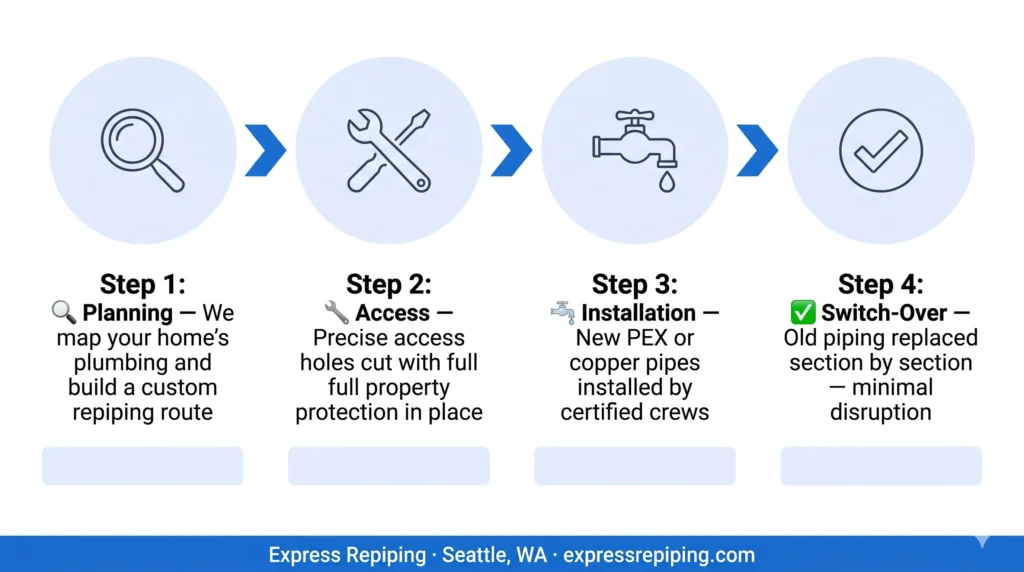
What to Expect: The Repiping Workflow
The entire process should be transparent and easy to follow:
- Planning: Professionals evaluate your home’s layout, pinpoint problem areas, and build a tailored repiping route.
- Access: You’ll know exactly where holes are being cut—and why. Expect protective covers for furniture and flooring.
- Pipe Installation: Certified crews install new PEX or copper pipes using tools that minimize noise and dust.
- System Switch-Over: Old piping is replaced section by section to keep disruptions as brief as possible.
Did you know? Most whole-home repipes in Seattle take just 2-5 working days, with many jobs completed in 2-3 days for single-family homes—speed matters when your water is off!
Home Protection and Cleanup: What You Should Ask
Keeping your property safe is non-negotiable. Here’s how true pros protect your home:
- Floor and furniture coverings: Drop cloths, plastic sheeting, and taped walkways
- Dust containment: Zippered plastic doors for major jobs, powerful vacuums for post-work cleanup
- Daily cleanup: All debris, drywall, and insulation hauled away—no mess left behind
- Water shutoff coordination: Clear schedules and backup plans for overnight needs
Ask these critical questions:
- How will you protect my home’s finishes, flooring, and valuables?
- Who handles drywall repair and painting after the job is done?
- Will my water be off overnight, and for how long each day?
- What’s the process for cleaning up debris and dust each day?
How a Trusted Repiping Company Handles Surprises
A trustworthy repiper should communicate daily, explain any schedule changes, and provide:
- Written scope of work with access points, repair tasks, and daily cleanup plans
- Contingency plans if water access must be extended or your project uncovers unexpected issues
- Real-life examples (such as photos or references) from similar homes in your neighborhood
“When the crew protects your home like their own, you can relax—repipe doesn’t have to mean chaos.”
“A detailed process and transparent scope of work are your insurance policy against unwelcome surprises.”
“The right team makes even the messiest job feel organized, safe, and stress-free.”
If you want minimal disruption, no mess, and crystal-clear timelines, always press for a project walkthrough, home protection strategy, and cleanup guarantee. This approach is the foundation for peace of mind during your repipe.
Project Timeline: What to Expect From Your Seattle Repiping Crew
| Home Type | Estimated Duration | Key Factors |
|---|---|---|
| Small single-story (1–2 bathrooms) | 1–2 days | Crawlspace or basement access, PEX material |
| Average single-family home (2–3 bathrooms) | 2–3 days | Standard layout, PEX or copper |
| Larger home (3+ bathrooms) | 3–5 days | More fixtures, longer pipe runs |
| Multi-story or complex layout | 4–7 days | Access challenges, additional wall repairs |
| Slab foundation home | 5–7 days | More invasive access, permit inspection pauses |
Picture this: Your entire home gets new pipes in as little as 2-5 days—without endless dust, strangers roaming your property, or confusion about who’s in charge. Understanding your repipe project’s timeline, crew composition, and site conduct is essential for a smooth experience and peace of mind.
Most whole-house repiping projects finish within 2–5 days for an average home in Seattle. Upscale or multi-story homes, or those with unique layouts, may take up to a week. A small single-story house can sometimes be completed in just 1–2 days.
What Affects the Project Schedule?
Your project’s timeframe depends on:
- Property size and number of bathrooms: More square footage and fixtures mean longer work.
- Construction type (slab, crawlspace, multi-story): Slab foundations often require more invasive access.
- Material: PEX installs faster than copper (up to 25% quicker in most cases).
- Change orders or hidden issues: Unforeseen complications like mold, water damage, or inaccessible lines.
- Permit and inspection turnaround: Some Seattle-area projects may pause for a day while awaiting city sign-off.
“Ask how long the crew will need your water off—will you have overnight access or need accommodations?”
Why Crew Composition and Professionalism Matter
A consistent, qualified team ensures efficiency and accountability. Here’s how to check:
- Are crews full-time employees or subcontractors? Employees are more likely to uphold company standards—and are covered by insurance.
- Are background checks completed for all on-site staff?
- Is there a dedicated supervisor or jobsite foreman each day?
You want to know who’s at your property—not random faces coming and going.
Questions to Ask About Timeline & Crew
When interviewing repiping companies, always ask:
- How long will the repipe take, start to finish, for my house type?
- How many people will be on the job, and are they your employees?
- What are your regular work hours, and who is my direct point of contact for schedule updates?
- What could delay the project, and how will you notify me?
“A clear, committed project timeline is the best insurance against costly delays and unwelcome surprises.”
What to Confirm Before Your Repipe Starts
Request a written timeline and crew list—it’s your best tool for jobsite clarity and a stress-free experience. Knowing who’s on the job and what to expect each day ensures you stay in control and can plan your life with confidence.
Testing & Inspections: How a Reputable Seattle Repiping Company Verifies Their Work
Ensuring your new pipes work flawlessly starts long before the water gets turned back on.
Thorough testing and inspections by your repiping company directly protect your home and wallet—no guessing involved, just data-driven, reliable results.
Inside the Standard Repiping Protocol
Reputable repiping companies in Seattle and Washington always perform a multi-step quality control process to guarantee a leak-free installation. Expect:
- Pressure testing: Once installation is complete but before walls are closed, the new piping system is filled to 1.5–2x normal working pressure. This confirms joints and fittings are airtight—no leaks, no exceptions.
- Diagnostic checks: Many pros use camera inspection tools or moisture sensors for hard-to-see spots, catching issues before they become problems.
- Pre-inspection walkthroughs: Technicians review every visible line with the homeowner, explaining routes, shutoffs, and new locations for peace of mind.
“A quality repipe is tested, photographed, and documented, not just patched behind new drywall.”
Regulatory Inspections—Your Built-In Safeguard
In most cities, including Seattle, city or county inspection is mandatory for code compliance and home insurance. A compliant company should:
- Pull all required permits on your behalf, listing themselves as the contractor of record.
- Arrange mandatory inspections with local authorities—never leaving you to chase bureaucracy.
- Remain present during the inspection, answering questions and ensuring your property passes the first time.
Ask your repiping contractor:
- How do you pressure-test the new piping, and can I see the results or photos?
- Will you be onsite for my city/county inspection? How do you handle any corrections?
- Do you provide me with written documentation or photos for my records and resale value?
“If your repiping company shrugs off official inspections or won’t share test results, it’s time to walk away.”
The Value of Rigorous Quality Checks
A detail-driven testing routine isn’t just about passing inspection—it’s about protecting your investment, your water quality, and your peace of mind for decades.
The best companies use a triple-layer method: internal testing + third-party inspection + full homeowner handoff—with annotated photos or warranty documentation for your files.
When you picture this process, imagine seeing real-time pressure gauges, clean pipe runs in every wall, and a pro confidently explaining every detail using your house as the teaching tool.
Ultimately, insisting on detailed testing and third-party inspection ensures your new pipes are fully code-compliant, futureproof, and backed by rock-solid documentation—the gold standard for stress-free home improvement.
Pricing & Estimates: What a Trustworthy Seattle Repiping Company Puts in Writing
Getting a detailed, transparent estimate is the single best way to prevent unexpected costs during your repiping project. A comprehensive quote protects your investment and clarifies exactly what you’re paying for—before any work starts.
The most trusted repiping companies in Seattle provide itemized, written quotes that break down every aspect of the job.
What Should Be Included in Your Estimate?
Always make sure your written estimate includes:
- Labor costs for all work performed
- Materials specified by brand and grade (PEX, copper, fittings)
- Permit fees for required city/county authorizations
- Drywall and painting repairs after pipes are installed
- Cleanup and debris removal—not just “basic” cleanup
- Warranties—clearly outlined coverage on labor and materials
“A lump-sum or verbal quote leaves too much to chance. If you can’t see it in writing, you can’t count on it.”
Understanding Payment Structures and Deposits
Repiping jobs are typically priced by the project, not by the hour. This gives you clarity and protection—no hourly surprises.
Check whether:
- Deposit requirements are reasonable (Washington law limits upfront deposits to 10% or $1,000, whichever is less)
- Progress payments are based on work milestones, not a fixed schedule
- Final payment is due only after city inspection and owner sign-off
Picture this: You’re reviewing a clear, itemized estimate versus a vague “all-in” number—the peace of mind is night and day.
Navigating Change Orders and Exclusions
Even great estimates can’t predict every possibility. When unexpected conditions pop up (hidden decay, code upgrades), a change order documents new work and costs—never agree to extra charges without written authorization.
Ask these questions before signing:
- What scenarios trigger change orders?
- Who authorizes extra work—and how is it priced?
- What isn’t included—like major structural repairs or fixture upgrades?
“Clarity now means no surprises later. If it’s not in the estimate, assume you’ll pay extra.”
Questions to Ask About Repiping Costs & Payment Terms
Protect yourself by asking companies:
- Will I receive a detailed, written estimate—not just a total price?
- What is included and what is not included in this quote?
- Can you explain deposit and payment schedules?
- How are changes and unexpected costs handled?
Transparent pricing sets the tone for trust and reliability—never hesitate to ask for details in writing. Thorough estimates, clear payment terms, and solid answers up front empower you to compare repiping companies on more than just price.
Warranties & Aftercare: What the Best Seattle Repiping Companies Offer
| Warranty Element | Industry Standard | Express Repiping |
|---|---|---|
| Coverage Term | 1–10 years | 25 years |
| Materials Covered | Varies — often pipes only | All pipes, fittings, and shutoffs |
| Labor Covered | Often excluded or limited | Fully included |
| Response Time | Not specified | 24–48 hours guaranteed |
| Written Copy Provided | Not always | Always — before work begins |
| Completion Walkthrough | Rarely included | Standard on every project |
Understanding the fine print around warranties and aftercare can make or break your investment in a repiping project. A strong warranty isn’t just paperwork—it’s your safety net against future leaks, defects, or workmanship issues.
Express Repiping stands out in Seattle with a 25-year warranty covering both materials and labor—over four times the industry minimum. Many companies offer just 1-10 years, often with restrictions.
Components Covered Versus Excluded
Always ask for clarity on:
- What’s covered: Repiping materials (copper/PEX), all fittings, shutoffs, and labor against leaks or malfunctions.
- What’s not covered: External fixtures, existing valves not replaced, cosmetic drywall/paint repairs unless specified.
For example, if a leak appears behind a wall from a replaced pipe, you should expect prompt, cost-free repairs under Express Repiping’s guarantee.
Why Written Guarantees and Aftercare Matter
A written warranty details your rights if problems surface, so there’s no guessing. Look for companies offering:
- Service response guarantees (e.g., 24–48-hour response for warranty issues)
- In-home inspection and repairs with no hidden charges during the warranty term
Transparent aftercare also means educated handoff—walkthroughs that show you shutoff locations and maintenance tips.
Questions to Ask About Warranties
Be direct. Use these must-ask questions before signing:
- What is the exact term and coverage of your workmanship and materials warranty?
- Is repair labor included if a leak or defect appears after installation?
- Will you provide a written copy of the warranty and service procedures?
- What isn’t covered—patching, older connections, or fixture installation?
- How quickly do you respond to warranty calls, and is there a dedicated support line?
What Seattle Homeowners Should Expect From Warranty Support
Picture this: Months after installation, you spot damp drywall. With Express Repiping, you call the support line, and a licensed repiping expert is scheduled for a same-week inspection—no service fee, no delays.
Strong, clear warranties and proactive aftercare are the backbone of your home’s value and peace of mind. Lock in long-term confidence by choosing a company whose guarantees are as rock-solid as their piping.
Communication & Documentation: Signs of a Reliable Repiping Company
Hiring a repiping company is about more than just pipes—clear communication and thorough documentation protect both your property and your peace of mind.
It’s essential to know who you’ll be speaking with and how to reach them if issues arise or questions come up after hours.
Many reputable companies assign a dedicated project manager or lead technician—someone who will be your real‐time lifeline throughout the process.
What Great Communication Looks Like
Picture this: Your repiping crew is making excellent progress, but suddenly you can’t find your main contact, and no one’s updating your schedule.
To avoid this frustration, insist on:
- A single, named point of contact from start to finish who is reachable by phone, text, or email
- Clear communication protocols for urgent updates (think water shutoff times, surprise findings, or schedule changes)
- A commitment to regular progress reports, so there are no unwelcome surprises
A trusted company will walk you step‐by‐step through their approach before work begins.
Documentation: Your Built-In Safety Net
High‐quality companies provide detailed, written documentation at every major project stage, including:
- Scope of Work summaries that outline every step—pipes replaced, fixture upgrades, access points, cleanup, and restoration
- Timelines that set expectation windows for each phase
- Homeowner preparation checklists with actionable tips like moving valuables or covering furniture
- Written warranties and aftercare instructions, so you’re never in the dark about what comes next
A photo recap of completed work (especially new shutoff valve locations) is increasingly standard and extremely helpful for future repairs.
Walkthroughs and Customer Education
Don’t underestimate the power of a hands-on walkthrough before final sign-off.
Express Repiping, for example, schedules a full completion walkthrough to:
- Show you exactly where new shutoff valves and mainlines are
- Demonstrate how your new system works
- Provide personalized maintenance tips specific to your new piping
- Answer all lingering questions face-to-face
A company committed to customer education empowers you to protect your investment for years to come.
Final Questions to Ask Before Hiring a Repiping Company in Seattle
To instantly gauge company fit, ask:
- “Who will be my single point of contact, and how can I reach them day or night?”
- “Can I see a written scope of work, with a schedule overview and prep checklist?”
- “Will there be a walkthrough at project completion, and will you provide photo documentation of key changes?”
- “How do you communicate schedule changes or findings that impact my home or daily routine?”
Don’t settle for vague assurances—great answers here show a company values your trust, not just your business.
Expect crystal-clear communication, meticulous documentation, and a company as invested in your peace of mind as they are in your piping. When these elements line up, you’re not just hiring a contractor—you’re gaining a skilled partner for your home’s future.
How to Tailor Your Repiping Questions for Your Seattle Home
When it comes to repiping, one-size-fits-all questions just don’t cut it—every home tells a different story.
Your property’s age, layout, and plumbing history will all shape what you need to ask.
For example, a 1940s Seattle craftsman with galvanized pipes will require a drastically different approach—and set of questions—than a 1990s suburban rambler with CPVC.
Start by writing down your home’s details:
- Year built
- Foundation type (slab, crawlspace, or basement)
- Number of stories and bathrooms
- Current pipe materials (if known)
- Recent plumbing issues (leaks, low pressure, rusty water)
Identify Your Highest-Impact Questions
To make your contractor conversations more productive, focus on what matters most for your specific situation.
Try grouping your questions by:
- Areas of visible damage or concern (e.g., basement, kitchen, exterior hose bibs)
- Unique features: Radiant heating, historic finishes, intricate tile, tight crawlspaces
- Times you can’t be without water (essential for families or businesses)
Picture this: You’re in a split-level 1970s home with a single bath. Ask about minimal water-off scheduling and access hole repair in finished spaces so you’re not left with wall patching headaches.
Tailor for Property Types and Special Circumstances
Properties with slab foundations need to address pipe routing and slab penetration.
Older historic homes might need questions about protecting original trim, lath plaster walls, or code upgrades.
If you have uncommon fixtures (steam showers, filtered water taps), ask:
- Are all current fixtures compatible with your proposed piping?
- Can specialty shutoffs, bibs, or filtration be integrated during the repipe?
The Express Repiping Checklist for Custom Projects
Narrow your list by using this 7-step framework:
- What’s the oldest part of my home’s plumbing?
- Where do recurring leaks or issues happen first?
- Are there areas I want preserved or protected at all costs?
- Will I need temporary water, especially for kids or tenants?
- Am I concerned about lead, rust, or water quality?
- How will access be gained in finished areas?
- What warranty and aftercare is realistic for my situation?
Show, don’t tell: Bring photos of problem areas or text your issues ahead, so contractors can prepare specific, insightful responses.
When you tailor questions this way, you’ll spend less time on guesswork and get straight to ironclad answers that protect your investment. The right questions give you a full picture—and set the stage for a repiping project that’s efficient, transparent, and built to last.
Your Next Step: Hiring the Right Repiping Company in Seattle
Choosing the right repiping company in Seattle isn’t just about fixing pipes—it’s about safeguarding your home, your peace of mind, and your investment for years to come.
When you ask the right questions and demand clear, honest answers, you take control of the process and set the stage for a smooth, stress-free repipe.
The right team doesn’t just replace your pipes — they deliver the reliability and clarity you deserve. Take the first step and get a free repiping estimate from Express Repiping today.”
—
Here are the most impactful actions you can take now to move forward confidently:
- Verify credentials: Always ask for and confirm licenses, insurance, and city permits—don’t settle for verbal assurances.
- Demand written estimates: Get every detail in writing, including materials used, timeline, scope of work, and warranties.
- Prioritize specialization: Choose a company that focuses specifically on repiping, with a proven track record and local references.
- Ask about home protection: Clarify how your property, finishes, and daily routines will be protected during each phase.
- Insist on documentation and aftercare: Request photo reports, walkthroughs, and a clear, written warranty for total peace of mind.
—
Ready for your next steps?
- Compile your personalized list of must-ask questions today—tailored to your property, concerns, and schedule.
- Schedule a free, no-obligation inspection and estimate with a certified, family-owned repiping specialist like Express Repiping.
- Reach out directly to discuss your goals—we’re here to answer every question and turn uncertainty into confidence.
—
Every question you ask is a step toward a safer, smarter, and more comfortable home. The right team doesn’t just replace your pipes—they deliver the reliability and clarity you deserve. Take the first step now, and empower yourself with knowledge—because when your pipes are running smoothly, so is your entire home.
How do I choose a reputable repiping company in Seattle?
Look for a licensed, insured contractor who specializes in whole-house repiping — not just general plumbing. Verify their Washington state plumbing license number, request proof of liability and workers’ comp insurance, and ask for local references from homes similar to yours. A reputable Seattle repiping company will handle all permits and city inspections on your behalf.
What questions should I ask before hiring a repiping contractor?
Ask about licensing, insurance, and permit handling; how many whole-house repipes they complete per year; which pipe materials and brands they use; how they protect your home during the project; and what their warranty covers. Getting clear, written answers to these questions before signing is the single best way to avoid costly surprises.
How long does a whole-house repipe take in Seattle?
Most whole-house repiping projects in Seattle take 2–5 working days for an average single-family home. Smaller single-story homes can sometimes be completed in 1–2 days, while larger or multi-story properties may take up to a week. Factors like foundation type, pipe material, and permit turnaround can affect the timeline.
Is PEX or copper better for repiping a Seattle home?
Both are excellent choices, but PEX is the most popular option for Seattle homeowners due to its flexibility, freeze resistance, and lower installation cost — typically $1,500–$3,000 less than copper for a whole-house repipe. Copper offers a longer proven track record and is preferred in some historic homes or HOA-governed properties. A qualified repiping company in Seattle will recommend the best material based on your home’s age, water chemistry, and budget.
What should a repiping estimate include?
A complete written estimate should itemize labor, materials (specified by brand and grade), permit fees, drywall and painting repairs, cleanup, and warranty terms. Avoid any contractor who provides only a verbal quote or lump-sum total — if it isn’t in writing, you have no protection against unexpected charges.
Do I need a permit for repiping in Seattle?
Yes. All whole-house repiping projects in Seattle require city permits and mandatory inspections. A licensed repiping company should pull all required permits on your behalf and schedule city inspections as part of the project. Never work with a contractor who suggests skipping permits — doing so can void your home insurance and create serious issues at resale.
What warranty should a repiping company offer?
A strong repiping warranty covers both materials and labor for at least 10 years, though the best Seattle repiping companies offer 25-year warranties. The warranty should be provided in writing before work begins and clearly state what is and isn’t covered, how quickly the company responds to warranty calls, and whether repair labor is included at no charge.