Choosing the right PEX A vs PEX B piping solution for Seattle’s freeze-prone winters is critical to protecting your property, improving long-term plumbing performance, and avoiding costly water damage.
Here are the essential insights to help you make an informed, confident decision—fast.
- PEX A delivers superior freeze resistance by expanding up to three times its diameter and bouncing back, providing unmatched protection against burst pipes and costly winter leaks.
- PEX B is budget-friendly but less flexible, making it suitable for heated interiors but more prone to micro-cracks after repeated freeze/thaw cycles in exposed areas.
- PEX A’s high cross-linking (85–89%) ensures up to 50 years of durability, while PEX B’s lower cross-linking (65–70%) results in shorter lifespans and greater risk in harsh climates.
- Industry tests show PEX A’s failure rates are under 5% at -4°F, compared to 10–15% for PEX B—translating to long-term reliability during Snohomish and Seattle cold snaps.
- Professional installation and insulation are musts—correctly installed PEX A with R-4 insulation dramatically reduces freeze risk in crawl spaces, exterior walls, and basements.
- Express Repiping warranties cover freeze failures for both PEX A and B with certified installs, but PEX A’s warranty specifically covers repeated freeze/thaw events for added peace of mind.
- Seattle codes demand insulation and proper PEX selection for all vulnerable pipe runs—Express Repiping guarantees all installs meet or exceed code, protecting your investment and property value.
- Investing 20–30% more in PEX A upfront can save you 200% or more on freeze-related repairs—delivering true, long-term peace of mind for your home or business.
For expert guidance and a free inspection, connect with Express Repiping—your Seattle specialists in freeze-proof plumbing and lifetime protection.
Introduction
Picture this: A winter cold snap hits Seattle overnight, and suddenly your pipes—hidden in crawl spaces and unheated basements—are put to the ultimate test. The wrong choice now could mean waking up to frozen lines, leaks, and thousands in repairs.
Seattle homeowners and property managers know freeze damage is more common than you think. In fact, burst pipes are among the top causes of home insurance claims in Washington State every year. Yet, not all pipes handle the Pacific Northwest’s unpredictable winters equally.
That’s where understanding the difference between PEX A and PEX B becomes critical in any PEX A vs PEX B comparison.
Many assume all PEX is created equal, but the science says otherwise—PEX A can expand up to three times its size without rupturing, while PEX B is more affordable but less forgiving under repeat freeze-thaw cycles.
Choosing the right PEX for your property isn’t just about avoiding winter emergencies. It’s about:
- Protecting your investment from hidden leaks
- Reducing emergency repair costs during harsh Seattle weather
- Ensuring a longer-lasting piping system that stands up to decades of cold snaps
We see it every year: homes that opted for the wrong material face costly insurance headaches, while others enjoy true peace of mind—especially with warranties that cover freeze-related failures for up to 25 years.
If you’re worried about pipes running through exposed areas, vacation homes left empty, or aging systems in need of an upgrade, the right PEX choice makes all the difference. In Seattle’s climate, “freeze resistance” isn’t a luxury—it’s an absolute necessity.
Wondering how PEX A and PEX B really compare—and which will protect your home when it matters most?
Let’s explore the key performance differences, freeze resistance, and what you need to know for smart, stress-free repiping in the Seattle area.
Understanding the Difference Between PEX A and PEX B in Cold Climate Applications
When it comes to freezing resistance in Seattle homes and businesses, choosing the right PEX piping can mean the difference between peace of mind and costly water damage.
PEX A and PEX B are both forms of cross-linked polyethylene tubing, but the way they’re made—and how they behave in freezing temperatures—differs dramatically.
The Science Behind PEX: What Sets A and B Apart
PEX A is produced using the Engel (peroxide) cross-linking method, which creates a highly uniform pipe structure and achieves 85–89% cross-linking.
When comparing the difference between PEX A and PEX B, PEX B uses the silane (moisture-cure) processCost, Warranty, and Local Code Considerations
, resulting in a slightly lower and less uniform cross-linking rate, typically 65–70%.
- PEX A: Extremely flexible, can be bent into tight curves
- PEX B: Stiffer, generally more budget-friendly, but less forgiving under freeze/thaw stress
This molecular difference is the reason you’ll often hear: PEX A is the “gold standard” for harsh winter climates.
Why Freeze Resistance Matters in Washington State
Picture this: A cold snap in Seattle, pipes running through crawl spaces and unheated basements, and the risk of overnight freezes shutting down water service or causing hidden leaks.
Freeze resistance is critical for:
- Single-family homes exposed to outdoor elements
- Vacation properties left unheated for long periods
- Commercial buildings with exterior or underground runs
Industry studies show PEX A can expand up to 3X its diameter without rupturing, while PEX B is more likely to develop “micro-cracks” after repeat freezes.
Industry Standards & Real-World Reliability
For peace of mind and compliance, always look for materials meeting ASTM F876, ASTM F2023, and PPI TR-3—the top benchmarks for freeze durability and lifespan.
Lab results reveal:
- PEX A failure rates under 5% at -4°F
- PEX B rates closer to 10–15% at the same extreme cold
Both far outperform copper or rigid PVC, but PEX A stands out for resilience over decades of harsh winters.
In Seattle’s fluctuating temps, that added margin means fewer costly repairs and longer-lasting infrastructure.
With freezing conditions an annual reality, choosing the right PEX—paired with expert installation—means protecting property, preventing leaks, and maximizing peace of mind. For cold-prone areas and any system with exposure risks, “freeze-proof” isn’t just a buzzword—it’s a must-have.
Comparative Freeze Resistance: PEX A vs PEX B Performance
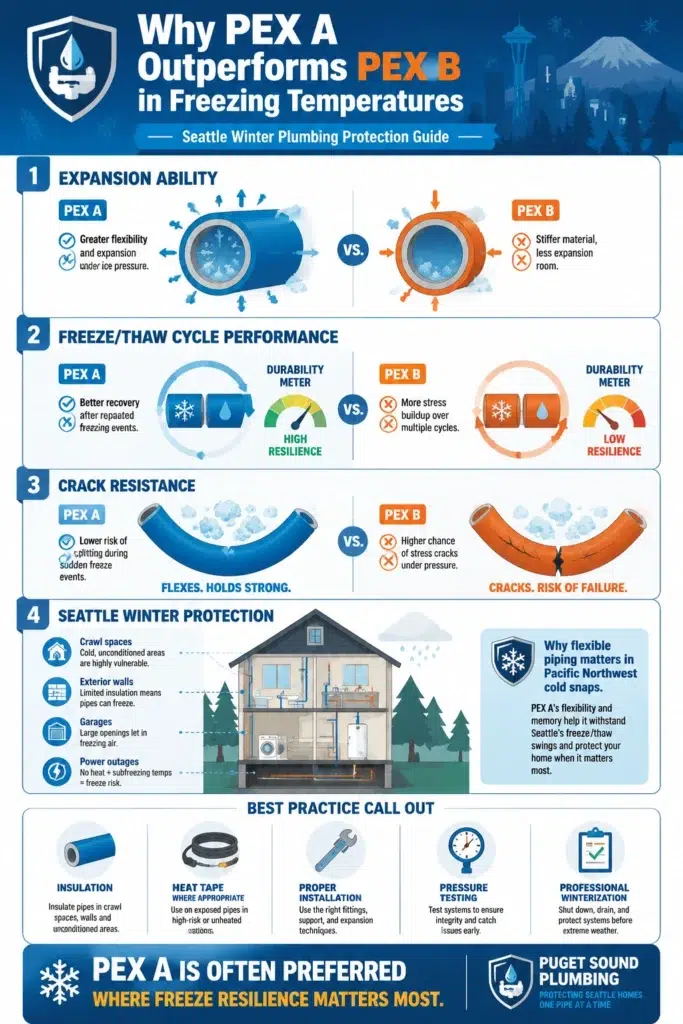
When comparing PEX A freeze resistance and PEX B freeze resistance, PEX A consistently performs better during repeated freeze and thaw cycles.
Mechanisms of Freeze Resistance
Another important factor in the pex a vs pex b burst pressure comparison is how each pipe responds to internal expansion caused by frozen water.
When temperatures plummet, PEX A’s enhanced elasticity is its standout feature.
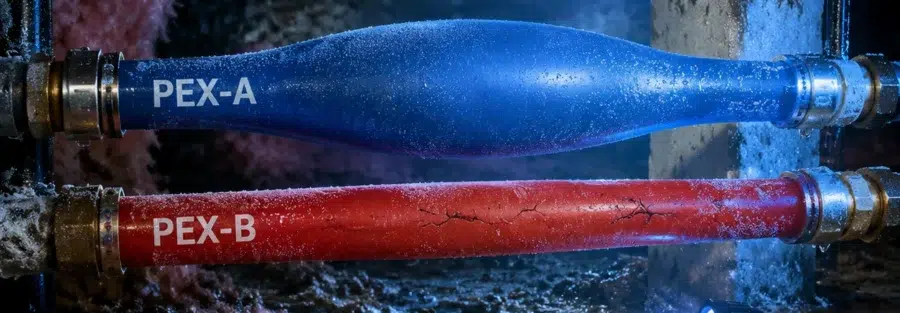
Picture this: PEX A tubing can expand up to three times its original diameter if water inside freezes, then return to its normal shape thanks to its “shape memory” after thawing.
PEX B starts flexible, but with repeated freeze/thaw cycles, its structure becomes rigid and micro-cracks may form—weakening the pipe over time.
- PEX A: High cross-linking (85-89%), super stretchy, “shape memory” returns pipe to normal.
- PEX B: Moderate cross-linking (65-70%), flexible at first, gradually stiffens with repeated freezes, micro-crack risk rises.
Takeaway: If your property faces freezing pipes, PEX A’s unique flexibility offers extra insurance against burst pipes.
Both PEX A and PEX B should comply with ASTM F876 standards to ensure durability, pressure resistance, and cold-weather performance.
Performance Under Extreme Conditions
Industry tests and real-world data tell a clear story.
Lab results (ASTM F876, F2023, PPI TR-3) show PEX A pipes have less than a 5% failure rate at -4°F, often withstanding burst pressures up to 500 PSI.
PEX B, while superior to rigid pipes, experiences 10-15% failure rates under identical conditions—especially after several freeze/thaw cycles.
Consider these test results:
- PEX A: Endures multiple freeze cycles, rare bursting, retains durability.
- PEX B: More likely to split, especially near fittings, after several freezes.
Real-world example: In Seattle’s cold winters, pipes in crawl spaces or exterior walls are put to the test. “A single overnight freeze can spell disaster for standard pipe—but PEX A rarely cracks,” according to Express Repiping’s technicians.
Implications for Residential and Commercial Installations
In any PEX A vs PEX B comparison, understanding how each pipe performs in residential and commercial installations is essential for preventing freeze-related plumbing failures and long-term water damage.
Freeze resistance isn’t just a technical talking point—it’s a property saver.
Whether you own a century-old Capitol Hill home or manage apartments with exposed plumbing, freeze-prone areas like:
- Crawl spaces
- Unheated basements
- Exterior wall runs
- Vacation homes left unattended
are all at greater risk.
With PEX A, you’re choosing fewer emergency repairs, longer lifespan, and greater peace of mind—especially in the unpredictable Seattle climate.
Express Repiping recommends PEX A for any pipes near unconditioned spaces or buildings with historical freeze damage. For budget-friendly projects in warm, protected interiors, PEX B remains durable, but the added protection of PEX A is worth the extra investment for exposed runs.
—
For Seattle-area property owners seeking true freeze resilience, PEX A’s expansion and recovery abilities deliver a level of performance standard rigid pipes—and even PEX B—simply can’t match. Choosing the right PEX type is more than a technicality—it’s about safeguarding your home all winter long.
Long-Term Durability and Lifespan in Cold Environments
Homeowners often ask, should I use PEX A or PEX B, especially when planning long-term plumbing upgrades in freeze-prone areas.
Cross-linking Levels and Pipe Aging
Durability starts at the molecular level. PEX A boasts an 85–89% cross-linking rate, while PEX B uses a 65–70% cross-linking percentage.
This matters because:
- PEX A’s higher cross-linking lets it withstand repeated freezing and expansion without weakening or splitting.
- In lab tests (ASTM F876, PPI TR-3), PEX A pipes hold up for 50+ years at 180°F and 80 psi, retaining 90% of their original tensile strength—even after 8,000 hours of stress.
- By contrast, PEX B typically shows a 30–40-year lifespan under the same pressures, and retains about 70–75% of its original strength after long-term test cycles.
Quotable: “In cold climates, the higher the cross-linking, the longer your pipe lasts, period.”
Effects of Freezing on Fittings and Joints
Joints are where leaks begin—especially after a freeze.
On the ground, here’s what our Seattle crews see:
- PEX A expansion fittings “breathe” with the pipe, holding seal integrity even after extended sub-zero exposure.
- PEX B’s crimp-and-clamp fittings are solid short-term, but repeated freezes can stress joints and trigger minor leaks over time—especially in crawl spaces or basements that hit frigid lows.
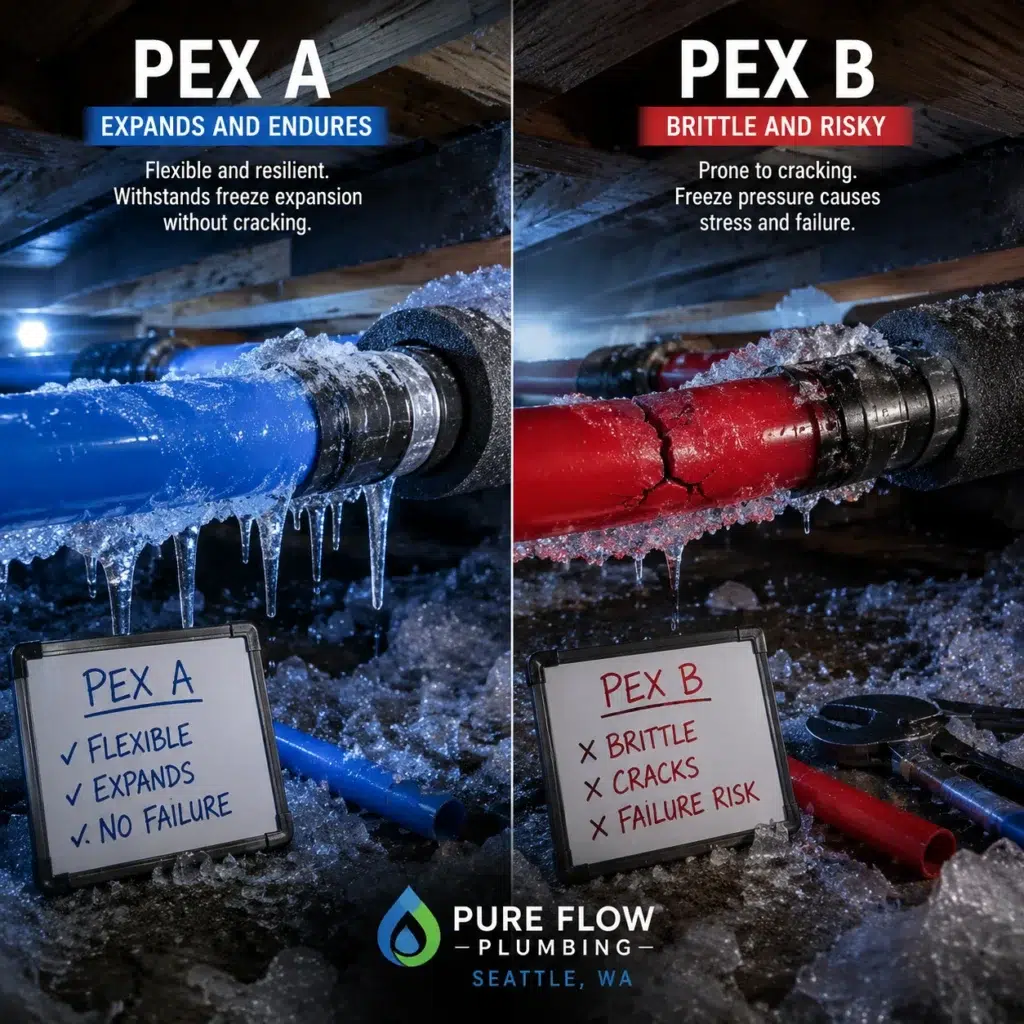
Visualize this: Picture a frozen crawl space—PEX A fittings flex without fail; PEX B fittings risk tiny splits unseen until thaw.
Major manufacturers now warranty freeze-resistant expansion joints for up to 25 years—but as always, any improperly installed joint is a weak link.
Mother Nature tests every connection. That’s why Express Repiping uses certified methods and offers lifetime leak support.
UV and Chemical Resistance Factors
Some property owners researching pex a vs pex b leaching want to know how each material reacts to water quality, chemicals, and prolonged environmental exposure.
Cold isn’t the only culprit. Seattle’s weather means exposure to UV light (windows, basements) and fluctuating groundwater chemistry.
- While PEX A resists both UV and chemical stress better than PEX B, it’s critical to shield any PEX pipe from direct sun.
- Sudden temperature drops make chemically aged or sun-exposed pipes more likely to fail—choose insulated, UV-protected routes on every install.
Quotable: “A pipe’s greatest enemy is what you don’t see—sunlight and chemicals age weak piping fast.”
Whether you’re repiping a modern home or winterizing a historic Seattle property, choose high-cross-link PEX for best freeze protection and decades of worry-free plumbing.
Best Practices for Installation in Freeze-Prone Areas
Material Selection Criteria
Reviewing a pex a vs pex b flow chart can help homeowners quickly identify the right pipe type based on climate, installation location, and budget.
Choosing the right PEX product is your first line of defense against winter plumbing headaches.
PEX A offers superior freeze resistance thanks to its high cross-link density (85-89%), extreme flexibility, and shape memory—ideal for Seattle’s unpredictable cold snaps.
PEX B is stiffer (65-70% cross-linking) and costs 20-30% less, making it an option for low-risk, heated spaces or budget installations.
Consider these factors before selecting:
- Property type: Single-family homes, multifamily, or commercial spaces with crawlspaces or outdoor runs need extra protection.
- Exposure risk: Pipes outside conditioned areas (unheated basements, attics, vacation homes) are best protected by PEX A.
- Local code: Seattle and Washington plumbing requirements may restrict pipe type or install method—always verify before starting.
Freeze protection isn’t just about pipe material:
- Use R-4 or higher insulation jackets on all exposed runs.
- Keep pipes at least 12″ off exterior walls when possible.
- Design systems with fewer joints and maximum flexibility to reduce weak points.
Installation Methods and Tool Considerations
Proper installation is critical for freeze resilience—and homeowner peace of mind.
- PEX A: Expansion fittings require a specialized tool; pipes spring back into shape after freezing and kinks can be repaired with a heat gun.
- PEX B: Uses crimp or clamp connections which are less flexible, slightly more vulnerable at joints, but easy for straightforward runs.
Express Repiping guarantees:
- Use of professional-grade tools and insulation for every project.
- Adherence to all Seattle and Washington codes—no shortcuts, no surprises.
- Fully licensed, insured technicians for worry-free workmanship and warranty coverage.
Picture this: After a hard freeze, your newly insulated PEX A line flexes and thaws without a hint of leaking—saving you thousands in potential repairs.
Maintenance, Monitoring, and Troubleshooting
Vigilance keeps pipes freeze-free year after year.
Quick maintenance checklist:
- Schedule annual visual checks before winter—look for pipes near drafty vents, poorly insulated garages, or crawlspaces.
- Install WiFi-enabled water sensors on vulnerable runs to catch leaks the moment they start.
- Keep heat circulating in utility areas during cold snaps, or let faucets drip when temperatures plunge.
Express Repiping makes it effortless:
- Free winterization inspections for all Seattle-area properties.
- Transparent, no-surprise assessments with tech-supported leak detection.
- Upgrade plans for aging, at-risk plumbing—no pressure, just honest advice.
The smartest defense is a proactive approach—choose PEX A for proven freeze protection, invest in expert installation, and schedule regular check-ups for stress-free winters. Peace of mind is always in season.
Professional PEX repiping installation ensures proper insulation, code compliance, and maximum freeze protection in vulnerable plumbing areas.
PEX A vs PEX B Cost, Warranty, and Local Code Considerations
When evaluating PEX A vs PEX B, understanding the difference in installation cost, warranty protection, and Seattle plumbing code requirements helps property owners choose the best long-term freeze-resistant solution.
Cost Implications of Freeze-Resistant PEX Systems
For property owners in Seattle and Washington, PEX A typically costs 20-30% more per foot than PEX B.
This higher upfront price reflects the advanced Engel cross-linking process and superior elasticity—key for cold climates.
Think of it as a one-time investment in peace of mind: PEX A’s exceptional freeze resistance translates to lower odds of catastrophic winter bursts.
Typical installed costs in Seattle range from $6.50–$8.50 per linear foot for PEX A, compared to $5.00–$6.50 for PEX B (labor included).
Over time, homes and commercial buildings with PEX A often see:
- Fewer emergency repairs caused by freeze/thaw cycles
- Lower insurance claims from burst pipes
- Reduced water damage costs, especially in unheated or exposed areas
“Saving 20% on pipe cost today can mean paying 200% more on freeze repairs tomorrow.”
Warranty Coverage and Peace of Mind
Express Repiping provides a 25-year warranty on both PEX A and PEX B installations—covering freeze-related pipe failures, material defects, and leaks when installed by our certified professionals.
Leading manufacturers (like Uponor and SharkBite) offer comparable warranties, but terms usually require installation by licensed and insured contractors.
- PEX A warranties often specify freeze/thaw performance as a covered event
- PEX B warranties may exclude repeated freeze damage or improper installation
With Express Repiping, every project comes with transparent documentation—so you know exactly what’s covered.
“Our warranty lets you sleep easy through the winter—if your pipes freeze, you’re protected.”
Navigating Local Regulations in Seattle and Washington
Seattle building codes allow PEX piping in new and remodeled plumbing—but require insulation for any runs in exterior walls, crawl spaces, or unheated zones.
Local inspectors check for:
- Correct PEX type selection for environmental risk zones
- Proper insulation and installation to meet city and state plumbing codes
- Project documentation to verify manufacturer compliance
Express Repiping guarantees all installs meet or exceed Seattle and Washington standards.
Before winter hits, we recommend:
- Free inspection of piping in vulnerable locations
- Upgrading insulation on exposed PEX runs
- System assessment to ensure code compliance and optimal freeze resistance
“Picture a cold snap—not a drop of water leaks from your pipes. That’s the Express Repiping standard.”
Seattle’s freeze-prone winters demand more than basic plumbing solutions. Choosing the right PEX, backed by a robust warranty and strict code compliance, means fewer headaches and lasting peace of mind. For full code checks, warranty details, or a free quote, our licensed team is standing by—so you can trust your pipes all year long.
Choosing Between PEX A and PEX B for Cold-Climate Repiping
Comparing pex a vs pex b size options is also important when designing efficient residential or commercial repiping systems.
When it comes to freezing resistance and performance, the choice between PEX A and PEX B directly impacts the long-term safety of your Seattle property.
If you want peace of mind in harsh winters, the numbers speak for themselves: PEX A expands up to three times its diameter without bursting, resists micro-cracking during repeated freeze/thaw cycles, and boasts a less than 5% failure rate at -4°F.
For homes with crawl spaces, unheated basements, or vacation properties left unattended, PEX A’s “shape memory” allows it to return to its original form after a freeze, minimizing leak risk.
Fast Facts for Smart Decisions
- PEX A: Best for freezing climates, complex plumbing runs, and long-term reliability.
- PEX B: A good fit when budget is a priority and pipes are in controlled temperatures.
- Average material cost for PEX A is 20–30% higher, but this can mean big savings on emergency freeze repairs.
When property value and protection are top priorities, most experts—including our certified team at Express Repiping—strongly recommend PEX A for cold-weather Seattle installations.
Picture This in Your Home
Imagine a sudden cold snap while you’re out of town—PEX A flexes and recovers, but PEX B, despite its strength, could crack at a fitting or joint.
- Burst pressure for PEX A approaches 500 PSI, far outlasting typical residential freeze conditions.
- Industry studies show PEX B failures from splits or leaks can be 2–3× as common after multiple freeze cycles.
“Your home’s water system is only as strong as its weakest link—choose flexibility for winter peace of mind.”
How Express Repiping Helps You Decide
We never push unnecessary upgrades. Your repipe specialist will assess:
- Pipe location (exterior wall, unheated garage, attic, slab, etc.)
- Severity of freeze risk and historical leak patterns in your neighborhood
- Your budget, water use, and long-term project goals
We’ll explain whether PEX B is a practical short-term option—for example, in a heated apartment block—or when it’s time to invest in the 25-year, code-compliant reliability of PEX A.
No stress, no obligation—get your free quote or book a walk-through today to map out the best freeze-resistant solution for your Seattle property.
The smartest cold-climate repiping plans start with an honest expert inspection and clear, personalized recommendations—let’s make sure your pipes are running smoothly all winter long.
Final Thoughts on PEX A vs PEX B
Choosing the right PEX solution sets the stage for years of reliable plumbing—especially in Seattle’s unpredictable freeze-prone climate. By putting freezing resistance and professional installation first, you protect your property, your peace of mind, and your budget for decades to come.
The difference isn’t just technical; it’s real-world protection. With the proper PEX type and expert workmanship, those cold winter nights lose their power to disrupt your home or business.
—
Here’s what you can do right now to secure your plumbing future:
- Prioritize freeze-resistant piping—install PEX A in any location exposed to temperature swings, exterior walls, or unheated basements.
- Insulate all vulnerable runs with high-grade jackets and keep pipes away from exterior walls whenever possible.
- Book a free inspection with certified technicians to identify at-risk spots and receive transparent, obligation-free recommendations.
- Insist on licensed, guaranteed installation for proper warranty coverage and peace of mind through every winter.
- Upgrade water sensors and monitoring for early leak detection before minor problems become major headaches.
—
Immediate steps for a worry-free repipe:
- Contact Express Repiping for a no-cost quote—get answers tailored to your property.
- Ask about PEX A vs PEX B recommendations based on your unique freeze risks.
- Review warranty and code compliance details to make an informed, future-proof decision.
- Schedule your walk-through today and take control of your plumbing investment.
—
When you invest in superior freeze protection—and back it up with local, certified expertise—your pipes become your strongest line of defense, not your weakest link.
“Winter-proof your home before the first snow falls—because real peace of mind starts with pipes you can trust.”
Let’s keep Seattle running smoothly, one repipe at a time.
If your home has aging plumbing or recurring winter pipe issues, our Seattle repiping services can help identify the best freeze-resistant solution for long-term protection.
FAQs
Is PEX A better than PEX B for freezing temperatures?
Yes, PEX A offers better freeze resistance because it can expand up to three times its diameter and return to its original shape after thawing.
What is the main difference between PEX A and PEX B?
The main difference between PEX A and PEX B is the manufacturing process, flexibility, and freeze resistance performance in cold climates.
Should I use PEX A or PEX B in Seattle?
PEX A is generally recommended for Seattle homes because of its superior freeze protection and flexibility in cold-weather conditions.
Does PEX B crack during freezing?
PEX B can develop micro-cracks after repeated freeze and thaw cycles, especially near fittings and exposed plumbing runs.
Which has higher burst pressure: PEX A or PEX B?
PEX A typically offers better burst resistance and flexibility under freezing pressure compared to PEX B.