
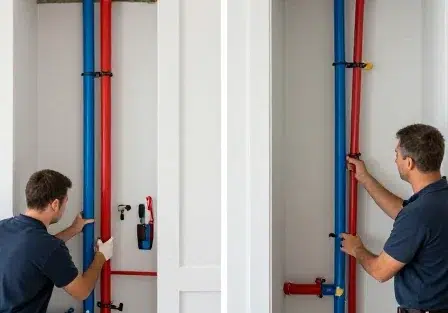
Choosing the right PEX piping isn’t just about letters—it’s about lasting value, installation ease, and year-round peace of mind for Seattle homes and businesses. Below, discover what truly matters when comparing PEX-A, PEX-B, and PEX-C, so you can make fast, confident decisions for your next repiping project.
- PEX-A offers maximum flexibility, allowing easy bends in tight spaces and quick, cost-saving repairs with a heat gun—perfect for Seattle’s vintage homes and complex remodels.
- PEX-B delivers unbeatable chlorine resistance and the highest burst pressure (500+ PSI), making it the top choice for full-home repipes and properties on treated municipal water.
- PEX-C is an eco-friendlier option but less available locally, best used for specific outdoor or specialty needs rather than general residential repiping.
- Fitting styles matter: PEX-A uses expansion fittings for full flow, while PEX-B and C rely on crimp/clamp fittings that may slightly reduce water pressure at joints; precise installation ensures lasting performance for all types.
- Professional installation typically cuts labor time by 20–30% over copper, especially with flexible PEX-A, keeping disruption and costs low for both homeowners and commercial properties.
- Cost and availability differ: PEX-B is the most affordable and widely stocked in Seattle ($0.40–$0.60/ft), while PEX-A commands a higher price but can offset costs with faster installations and easier repairs.
- Seattle’s freeze-prone climate favors PEX-A, which flexes and rebounds after cold snaps, whereas PEX-B is preferred for chemical durability in high-chlorine environments.
- Partnering with a certified, transparent repiping specialist like Express Repiping guarantees 25-year warranty coverage, local code compliance, and stress-free project management from quote to walkthrough.
Ready to make a confident PEX choice for your home or building? Dive deeper into our full guide and schedule your free, expert Seattle inspection for guaranteed results and year-round peace of mind.
Introduction
Sudden drop in water pressure, mystery puddles on the floor, or rusty water staining your laundry? You’re not alone—plumbing issues cost Seattle homeowners thousands every year, often because of aging pipes or confusing choices in pipe materials.
It might surprise you, but over half of Seattle’s recent full-home repipes now use PEX piping—and for good reason. With its exceptional flexibility, longevity, and cost efficiency, PEX offers solutions that older materials like copper or galvanized pipes just can’t match, especially in our unpredictable climate.
But here’s the question every property owner faces:
What’s the real difference between PEX-A, PEX-B, and PEX-C—and which one protects your home best?
The answer isn’t just about cost or convenience.
The type of PEX you choose impacts:
- How easily your pipes navigate tight corners and hidden crawl spaces
- How your plumbing stands up to Seattle’s freezing winters and high-chlorine municipal water
- The long-term value, safety, and warranty coverage for your most valuable asset
Choosing the right type can mean the difference between a stress-free repipe and years of surprise repairs.
At Express Repiping, we believe in empowering every customer—whether you’re planning a single-family remodel or maintaining a multi-unit building—with the knowledge to choose the piping that’s truly right for your unique needs. As Seattle’s certified repiping specialists, every project we complete is backed by expert advice, transparent pricing, and our industry-leading 25-year warranty.
In the following guide, you’ll discover:
- The real-world pros and cons of each PEX type
- How cross-linking methods affect durability, flexibility, and repairability
- Which PEX stands up best to local water and weather
- Where each type shines (and where it falls short)—so you can make your decision with clarity and confidence
Wondering which PEX offers the peace of mind—and performance—your home or building deserves?
Let’s break down what you truly need to know, starting with a quick look at how each PEX type is made and what that means for your next plumbing upgrade.
Understanding PEX Pipe Types: A, B, and C
PEX piping has become a top choice in modern plumbing, prized for its durability, flexibility, and lifespan compared to traditional materials like copper or PVC. With more than 50% of all new plumbing projects in Seattle and across the US now using PEX, understanding your options is essential for both homeowners and property managers.
What does “PEX-A,” “PEX-B,” or “PEX-C” actually mean? These are not quality grades, but refer to distinct cross-linking methods used in manufacturing—each of which impacts the pipe’s performance, repairability, and price in key ways.
Picture this: Choosing the right PEX type influences not just costs, but also how easily pipes navigate tight corners, how resilient they are against harsh winters, and even the long-term value of your property.
Express Repiping is Seattle’s trusted PEX expert, handling all types for full-home, multi-family, and commercial repipes—so you get both the optimal tubing for your property and peace of mind with a 25-year warranty.
—
How PEX Types Are Made: Cross-Linking Methods
Each PEX type is created through a unique process:
- PEX-A (Peroxide/Engel method): Cross-linking happens during extrusion, at high heat and pressure, yielding the most flexible and kink-resistant pipe. It’s a favorite for challenging installations in older Seattle homes.
- PEX-B (Silane/Moisture Cure method): Cross-linking occurs after extrusion with a silane catalyst and steam exposure. The result is a stiffer, more dimensionally stable pipe with superior chlorine resistance—ideal for properties using Seattle’s high-chlorine municipal water.
- PEX-C (Electron Beam method): Uses a high-energy electron beam for cross-linking after extrusion. This method is environmentally friendlier, but can produce slightly less uniform pipes, limiting its popularity.
How does manufacturing affect real-world use?
- PEX-A: Bends easily around obstacles, can be heat-repaired if kinked, but costs more.
- PEX-B: Harder to bend, holds shape (coil memory), requires clean, precise crimps, but offers unbeatable chemical resistance at a lower cost.
- PEX-C: Sits between A and B in strength and flexibility, but is less common and harder to source locally as of 2025.
—
“Knowing your PEX type can save thousands in long-term repairs.“
“Not all PEX is created equally—method matters as much as material.“
In summary: The right PEX type means fewer headaches, lower lifetime costs, and safer, more reliable plumbing. Express Repiping matches the best material to your project’s needs—giving you clarity, not confusion, every step of the way.
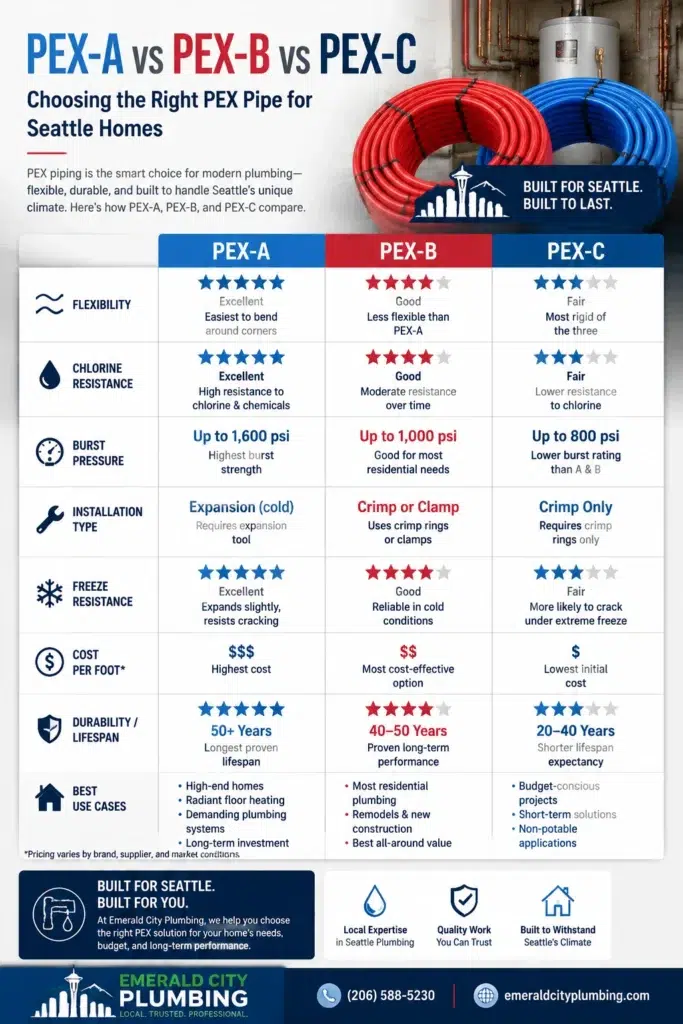
Side-by-Side Comparison: Key Properties and Performance
Choosing between PEX-A, PEX-B, and PEX-C isn’t just about picking a letter—it’s about performance, handling, and long-term value for your property. Below is a rapid-reference table highlighting the vital differences you need to know right now.
—
| Property | PEX-A | PEX-B | PEX-C |
|——————|——————————|———————————-|———————————-|
| Flexibility | Very high | Low, stiff | Moderate |
| Kink Repair | Heat gun fixes kinks | Kinks = replace section | Limited kink repair |
| Burst Pressure | 400–500 PSI | 500+ PSI (highest) | 400+ PSI |
| Chlorine Resistance | Moderate | Excellent | Good |
| Fitting System | Expansion (no restriction) | Crimp/Clamp (some restriction) | Crimp/Clamp (some restriction) |
| Material Cost | Highest | Lowest | Moderate |
| Best For | Tight spaces, cold climates | Value, high-chlorine water | Select outdoor uses |
—
Flexibility, Kinking, and Handling
- PEX-A stands out for maximum flexibility; you can bend it around corners in older Seattle homes and repair kinks in seconds using heat.
- PEX-B is more rigid and has “memory,” meaning it wants to snap back into a coil—if it kinks, you’ll need to cut out the damaged piece.
- PEX-C offers a compromise: more bendy than B but less forgiving than A, and repairing kinks isn’t always 100% successful.
Picture this: Snaking a pipe through a century-old wall cavity? PEX-A bends smoothly, while PEX-B and PEX-C may require more wall demolition.
“PEX-A is the go-to for tricky layouts—if you can imagine the curve, it can likely make that turn.”
—
Burst Pressure, Freeze Resistance, and Durability in Seattle’s Climate
- PEX-B wins on raw numbers for burst strength (often exceeding 500 PSI), but PEX-A shines in freezing conditions—it flexes and returns to shape after thawing.
- PEX-C performs well, but with fewer Seattle installs, it’s less proven during harsh winters.
All types meet ASTM F876/F877 standards for safety. Express Repiping backs every install with a 25-year warranty, so you’re protected season after season.
“Seattle freeze risk? PEX-A pipes can take a hit and bounce back—imagine thawing with no burst pipes or frantic repairs.”
—
Chemical Resistance and Water Quality Factors
- PEX-B is unmatched in chlorine and oxidation resistance—ideal for Seattle’s treated municipal water.
- PEX-A may experience slow wear in high-chlorine water, a factor for homes with decades-old underground lines.
- PEX-C holds its own for most chemical exposures except extremely harsh environments.
If water quality and longevity are top concerns, PEX-B offers peace of mind and the longest track record.
—
Connection Styles and Joint Flow: Fittings Matter
- PEX-A uses expansion fittings that allow for full flow, so you won’t lose pressure at the joints.
- PEX-B and PEX-C rely on crimp/clamp fittings, which may reduce flow slightly at each joint.
- Both expansion and crimp systems are proven if installed precisely—Express Repiping’s certified crews guarantee leak-free, factory-perfect connections.
Scenario for video: See how quickly an expert expands a PEX-A joint versus the careful precision needed for PEX-B crimp rings.
“Fittings can make or break a project: the right tools and steady hands keep water flowing (and leaks away) for decades.”
—
When you’re weighing PEX types, think about installation space, climate, water chemistry, and long-term access. The right choice means lasting performance—with Express Repiping, certified installs and 25-year peace of mind come standard.
Installation Considerations and Practical Challenges
Choosing the right PEX material isn’t just about performance—it’s about installation ease, tools required, and fitting your property’s needs.
Most homeowners want a pipe that can handle tight turns, tough corners, and Seattle’s variable climate without headaches or expensive surprises.
Ease, Time, and Learning Curve: What To Know
Each PEX type presents a unique experience during installation:
- PEX-A: Extremely flexible for tricky routes and tight spaces—perfect for Seattle’s older homes or dense retrofits.
- PEX-B: More rigid, which makes long straight runs easier but complicates work in cramped areas due to “coil memory.”
- PEX-C: Sits between A and B for flexibility, but tends to be used less often due to manufacturing quirks.
DIY installation is possible but comes with a steep learning curve—professional installation often saves hours, reduces rework, and prevents leaks.
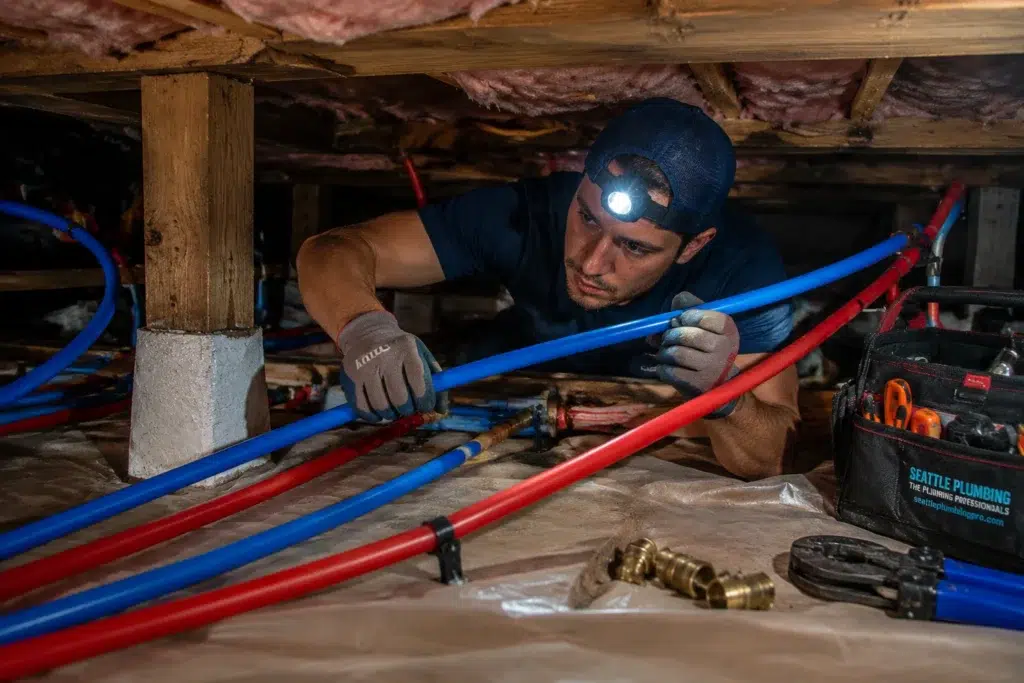
Picture this: Fitting PEX-A around a sharp joist bend under your kitchen can save replacing an entire pipe section, while PEX-B may force you to reroute or splice more often.
Bending Radius and Coil Memory
Understanding how PEX bends can make or break your project:
- PEX-A: Can bend as tightly as 6x the pipe diameter.
- PEX-B/PEX-C: Need a looser bend—minimum 8x the pipe’s outside diameter.
Coil memory for PEX-B and C means those pipes try to “spring back” to their rolled shape, making neat installation harder in confined spaces.
For Seattle’s classic bungalows, installers often see PEX-A as the go-to for minimizing wall, floor, and ceiling tear-outs.
Local Codes and Permitting
In Seattle and Washington, plumbing codes demand compliance with ASTM F876 and F877 standards for all PEX installations.
Permitting is mandatory for repipe jobs, especially multi-family and commercial projects. It’s not just about safety—local code compliance protects your property’s value and insurance eligibility.
- Historic homes? Some neighborhoods may require additional materials review before approving full house repipes.
Best PEX for Each Property Type
- Single-family homes: PEX-A for maneuverability; PEX-B for straight, open layouts and cost savings.
- Multi-family: PEX-B often preferred for longer runs and budget concerns.
- Commercial buildings: Mix of PEX-A for complex routing, PEX-B for main lines.
Tools Required for Each PEX Type
Here’s what you need to get the job done right:
- PEX-A: Expansion tool (for cold expansion fittings), durable and ergonomic.
- PEX-B/PEX-C: Crimp or clamp tools (for insert fittings), precision required for reliable, leak-free joints.
Homeowners: Expansion tools can be more expensive upfront, but reduce the risk of improper connections. Crimp tools are more affordable but require careful technique.
Pros: Express Repiping uses only industry-approved, perfectly calibrated tools, ensuring every joint meets manufacturer specs—backed by our 25-year warranty.
Shareworthy insights:
- “Choosing the right PEX means matching flexibility to your home’s quirks—not just picking what’s cheapest.”
- “Every minute saved with flexible PEX-A in a crawlspace means less disruption and faster hot water restoration.”
- “Professional-grade tools, not shortcuts, deliver leak-free results Seattle homeowners and businesses depend on.”
The upshot: Aligning your PEX type and tool system to your building, code requirements, and installer skill can cut labor costs by up to 20% and sidestep future headaches. Always insist on installations that pair the right PEX with the right tools and local expertise—your property’s longevity depends on it.
Cost, Availability, and Value Over Time
Picture this: you’re planning a repipe in your Seattle home and want to know which PEX type delivers the best value—immediate cost savings and peace of mind for years to come.
2025 Market Trends and Price Standouts
PEX remains the budget-friendly champion in 2025, but material prices and supply have shifted:
- PEX-A: Tubing averages $0.60–$1.00 per foot (highest), but expansion fittings keep downstream costs low.
- PEX-B: Tubing costs $0.40–$0.60 per foot—lowest overall—making it the most common for Seattle full-house repipes.
- PEX-C: Sells for $0.50–$0.80 per foot, but get this—limited availability means you might wait weeks for delivery or pay more in tight markets.
Installation labor is usually 20–30% lower with PEX than copper, especially for complex retrofits in older homes.
Breaking Down Total Installed Cost
When calculating the installed price for your property, consider:
- Material cost: PEX-A still carries the highest sticker price per foot.
- Fitting cost: PEX-A’s expansion fittings are the most affordable; PEX-B/B-C crimp/clamp fittings are pricier but readily available.
- Labor: PEX-A’s flexibility speeds up tricky installs, keeping labor bills down. PEX-B and C may take longer due to tougher bends and coil memory.
- Permit & demo: Local codes in Seattle often require city permits—budget $300–$1,000, depending on building age and scope.
Expect to pay:
- $4,500–$8,500 for a typical Seattle single-family repipe (PEX-B)
- $5,000–$9,500 for a PEX-A system in the same property (labor offset by faster install)
- Add 10–25% for difficult access, commercial properties, or extensive demolition
“These aren’t just pipes—they’re a foundation for your family’s daily comfort for decades.”
Long-Term Value, Repairs, and Warranty Coverage
- PEX-B: Best long-term bang for your buck for high-chlorine Seattle water; lowest risk of chemical damage, minimal repairs expected.
- PEX-A: Recommended in remodels, tight attics, or cold weather; any kinks? Quick fix with a heat gun—no costly pipe cuts.
- PEX-C: Moderate performance and price, but warranty and part delays can create headaches.
Express Repiping includes a 25-year labor and material warranty on every install—true peace of mind no matter your PEX choice.
For Seattle homeowners, the smartest move is to balance upfront savings with long-term resilience: Choose the right PEX type for your water and building, and invest in certified expert installation.
Use Cases, Best Applications, and Selection Guide
Choosing the right PEX type isn’t just about cost—it’s about matching your plumbing system to your home or building’s unique needs, Seattle’s climate, and your peace of mind.
PEX Types in Real-World Scenarios
Picture this: You’re upgrading a 1940s Seattle Craftsman or handling plumbing in a busy restaurant downtown—the optimal PEX choice will make every difference.
- Remodels & Tight Spaces:
- PEX-A: The gold standard for flexibility.
- Bends tightly around corners and beams—essential in basements, crawl spaces, and vintage homes.
- Kinks easily repairable with a heat gun, sparing you costly pipe replacements.
- Full-Home Repipes in Older Seattle Houses:
- PEX-B: Offers robust chemical resistance (ideal for Seattle’s varying water quality).
- Best balance between affordability and longevity for homes needing complete re-piping.
- Coil memory may present minor installation challenges but nothing a professional can’t handle.
- Commercial & High-Demand Applications:
- PEX-B: Delivers the highest burst pressure—minimizing the risk of leaks in high-usage or multi-story environments.
- PEX-A: Still a solid contender when flexible routing and fast installs are critical.
- PEX-C: Limited role—most often used where environmental or specific chemical exposure is a factor, but less commonly stocked or installed.
Suitability for Seattle’s Climate and Water Conditions
Seattle winters test any plumbing.
- PEX-A shines in freezing weather:
- Expands without bursting.
- Favored for homes with exposed piping in unheated spaces.
- PEX-B safeguards against chlorine:
- With the highest chlorine resistance, PEX-B is built for Seattle’s treated municipal water systems and ensures decades of reliable flow.
- Older infrastructure?
- PEX-A’s flexibility makes it ideal for retrofitting through tight, existing frameworks—like threading through old joists and behind walls without large demo jobs.
Decision Framework: Choose with Confidence
- Choose PEX-A if you need maximum flexibility, heat-fixable kinks, or are repiping in a home with complex layouts or cold-exposed runs.
- Choose PEX-B for the best bang for your buck, especially where high chlorine resistance and burst protection are mission-critical.
- Choose PEX-C only for rare, niche applications where specialty chemical exposure or environmental considerations demand it.
“The right PEX saves money and stress—choose what matches your home, water, and peace of mind.”
For deep dives on PEX fittings, tool options, or price breakdowns, check our dedicated guides—or call for a tailored, free Seattle inspection today.
Every property is unique, but understanding these use cases means you’re now equipped to pinpoint the PEX that delivers the quality and reliability your plumbing truly needs.
Choosing a Trusted Repiping Partner in Seattle
Choosing the right repiping partner is just as important as picking the right PEX type. Expertise, certification, and local reputation all play a big role in your project’s end result. With plumbing repairs, you want a team that not only knows every pipe and code in Seattle, but also treats your home or building with the care it deserves.
What Sets Reliable Repipers Apart
A dependable repiping contractor in Seattle should offer:
- Certified, licensed, and insured specialists—every Express Repiping technician is qualified to handle PEX A, B, or C installs
- Transparent pricing—detailed, up-front estimates so you never face surprise costs
- Free on-site inspections and honest recommendations tailored to Seattle’s unique climate and code requirements
- Industry-leading 25-year warranty for total peace of mind
“A quality repipe isn’t just about new pipes—it’s about confidence in your water for decades to come.”
Walk Through the Professional Repiping Process
Picture this: You schedule a free quote and a real specialist shows up on time, ready to explain the process, answer every question, and give you honest advice.
You’ll experience:
- Initial assessment: Your entire plumbing system is examined using the latest diagnostic tools
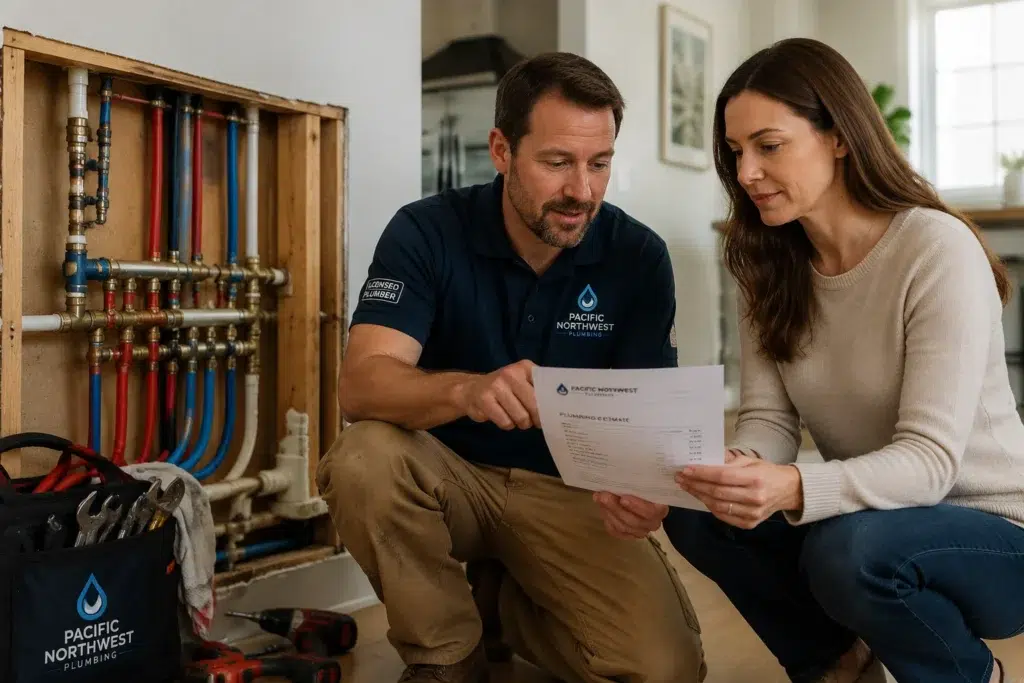
- Clear scope and estimate: Everything is outlined in plain language, from materials to timeframes
- Seamless installation: Your home’s daily life is carefully protected, with projects often completed in just 1-3 days for most single-family homes in Seattle
- Final walkthrough: After installation, you’ll get a full review, photos of the work, and warranty details—no loose ends, no hidden questions
“From your first call to water flowing from brand-new pipes, you’ll know exactly what’s happening every step of the way.”
Taking the Next Step With Confidence
Seattle homeowners expect more than patchwork plumbing. They want repipe contractors who listen, advise, and guarantee their work.
- Get a FREE, no-obligation quote today—see exactly what your property needs
- Call for answers to any questions, big or small
- Schedule a professional site visit—your comfort, water quality, and property value are always front and center
Working with Express Repiping means “you’re choosing a partner who stands behind every pipe, every fitting, and every promise.” The most valuable step is picking pros who deliver not just pipes—but peace of mind for decades ahead.
Conclusion
Choosing the right PEX type isn’t just a technical decision—it’s a long-term investment in your property’s comfort, safety, and value. Seattle’s unique climate and plumbing infrastructure demand solutions you can trust for decades, and your selection today impacts water quality, future repairs, and your daily peace of mind.
Here are the key takeaways that will help you make your PEX decision with total confidence:
- Match your PEX type to your property:
PEX-A delivers flexibility for tricky Seattle layouts and freeze resistance;
PEX-B offers the best value and top chlorine protection for most homes;
PEX-C is for rare specialty applications.
- Consider installation and repair practicality:
Choose materials that fit your space and your repair preferences—flexibility and easy kinking fixes can save thousands over time.
- Insist on certified, local expertise:
Professional installation ensures full code compliance, leak-free results, and warranty-backed peace of mind.
- Don’t overlook long-term costs:
Total value goes beyond sticker price—weigh labor, durability, warranty, and future repair needs together.
- Empower yourself with transparent service:
Free inspections, clear estimates, and knowledgeable support are your foundation for stress-free repiping.
Ready to take the next step?
- Book a free on-site inspection to see exactly which PEX option fits your home or commercial project.
- Get detailed, honest guidance—our team answers every question and walks you through the process.
- Request your no-obligation quote and discover why Seattle trusts Express Repiping with their most important plumbing projects.
Upgrading your pipes isn’t just about water flow—it’s about protecting your home and securing peace of mind for years to come. Let Express Repiping show you how expert choices and certified installation can make every shower, sink, and family gathering worry-free.
“Choose the right PEX, choose the right partner—invest in plumbing that gives you confidence, one pipe at a time.”
All installations should comply with Washington State Plumbing Code and ASTM-certified piping standards for long-term safety and durability.
FAQs
What is the difference between PEX A vs PEX B vs PEX C?
PEX-A is the most flexible and freeze-resistant option, PEX-B offers the best chlorine resistance and affordability, while PEX-C is mainly used for specialty applications with moderate flexibility.
Which PEX pipe is best for Seattle homes?
For Seattle homes, PEX-A works best in freeze-prone and older properties with tight spaces, while PEX-B is ideal for municipal water systems with higher chlorine levels.
Is PEX-A better than PEX-B?
PEX-A is better for flexibility and easier repairs, but PEX-B is more affordable and highly resistant to chlorine exposure. The best choice depends on your property and water conditions.
Does PEX piping increase home value?
Yes. Modern PEX repiping improves plumbing reliability, water quality, and buyer confidence, especially in older Seattle homes.
How long does PEX piping last?
Professionally installed PEX systems can last 40–50 years or more with proper installation and maintenance.
Is PEX safe for drinking water?
Yes. Certified PEX piping meets ASTM and plumbing safety standards for potable water systems.
Before starting any plumbing upgrade, compare the flexibility, chlorine resistance, and freeze protection discussed in our PEX A vs PEX B vs PEX C guide to ensure your repiping project delivers long-lasting performance and peace of mind.